Quick answer: HEC has officially released the HAT-MS answer key for the test held on July 4 & 5, 2026. You can download it directly from HEC’s official announcements page, organized by category and booklet color (Blue, Green, Pink, White, Yellow). Match your booklet color to the correct PDF to calculate your expected score before the official result.
If you sat the HAT-MS test on July 4 or 5, this is the update you’ve been refreshing your browser for. Here’s exactly how to find your key, use it correctly, and what happens next.
Where to Download the HAT Answer Key
HEC publishes answer keys through its official announcements page, not through a general Google search result — always go straight to the source to avoid outdated or incorrect keys circulating on unofficial pages. The official HEC announcement for this test lists separate PDF files for each category and booklet color combination.
How to Find Your Specific Key
HAT-MS was administered across five categories, and within each category, question booklets were distributed in five different colors to prevent copying between adjacent test-takers. That means you need to match both your category and your booklet color exactly — using the wrong color key will give you a completely inaccurate score estimate.
Steps to download:
Check your admit card or booklet cover for your exact category (General, or Category I, II, III, etc.)
Check the top corner of your question booklet for the color — it’s printed clearly on the cover
Go to the official HEC announcement page linked above
Find the file matching your category and color exactly (files are named clearly, e.g., “HAT-MS-GENERAL-AnswerKey-White”)
Download and open the PDF
How to Calculate Your Expected Score
Once you have the correct key, go through your recorded answers question by question. HAT scoring typically awards one mark per correct answer with no negative marking for incorrect ones — so there’s no penalty for guessing, which means a slightly lower calculated score from the key is still worth taking seriously if you left several answers blank.
Add up your correct answers, then compare that number against previous test cycles’ cutoffs for your category if you want a rough sense of where you stand — though HEC determines the actual passing threshold after each test cycle, so treat this as an estimate, not a guarantee.
What Happens After the Answer Key
The answer key isn’t your final result — it’s a self-assessment tool released ahead of the official scorecard. Based on HEC’s typical timeline for HAT test cycles, official results are usually published on the ETC portal within a few weeks of the answer key release. Once available, you’ll check your actual result using your CNIC or roll number on the ETC portal, not through the answer key page.
What If You Think a Question Was Wrongly Keyed
If you believe a specific answer in the key is incorrect, HEC does not typically offer a rechecking or challenge facility for HAT the way some other standardized tests do. Your best move is to double check the question against your booklet carefully first — a mismatch is often a booklet-color mix-up rather than an actual keying error.
Frequently Asked Questions
When was the HAT-MS test this key applies to held? July 4 and 5, 2026, across five categories.
How do I know which booklet color I had? It’s printed on the cover of your question booklet, along with your category. Check your admit card if you’re unsure.
Is there negative marking on the HAT test? No — HAT scoring awards marks for correct answers only, with no deduction for incorrect ones.
When will the official HAT result be announced? HEC typically releases official results a few weeks after the answer key, through the ETC portal using your CNIC or roll number.
Can I request a recheck if I disagree with the answer key? HEC does not generally offer a rechecking facility for HAT. Double-check your booklet color and category match before assuming a keying error.
Where can I prepare for a future HAT test if I need to retake it? See our full HAT test preparation guide for study resources and test structure.
How to Add FareHarbor to WordPress (And Not Lose Your Commission Like I Did)
I almost cost my client real money on their first month of bookings. Not because the integration broke. Not because the plugin had a bug. Because I forgot to set the ASN.
If you don’t know what that means yet — you will by the end of this guide. And you won’t make the same mistake I did.
I’ve built FareHarbor WordPress sites for three tourism brands in Aruba: Pelican Adventures, De Palm Tours, and Kukoo Kunuku. Each one is a separate WordPress site, each targeting a different audience, each with its own booking flow. I’ve gone through the plugin setup, the shortcode configuration, the multi-brand partner pages, and yes — the moment where commissions weren’t tracking and I had to figure out why.
This guide is everything I learned doing it for real clients, not just reading the docs.
What Is FareHarbor and Why Tourism Sites Need It on WordPress
FareHarbor is the booking system that most serious tour and activity operators use. It handles availability, payments, customer communications, and operator commissions all in one place. If your client runs boat tours, island excursions, or any kind of ticketed experience — they’re probably already on FareHarbor or about to be.
WordPress is where most of these businesses want their public-facing site. So connecting the two is one of the most common requests I get from tourism clients.
The good news: FareHarbor has an official WordPress plugin. The bad news: the plugin documentation tells you the minimum, not the reality. There are decisions you need to make before you even install it — and if you skip them, you’ll spend hours debugging something that should have taken 20 minutes.
Let me walk you through the whole thing.
Step 1: Start With the Client’s Goal, Not the Plugin
Most developers jump straight to installing the FareHarbor plugin. I used to do this too. Now the first thing I do is ask the client one question: what are you actually trying to achieve with this integration?
That question changes everything.
Some clients want a simple “Book Now” button on their homepage. Others want a full availability calendar embedded on each tour page. Some are resellers who earn commission on other operators’ bookings — and that requires a completely different setup than a direct operator.
If you skip this conversation, you’ll build the wrong thing. I’ve seen developers embed a full calendar when the client just needed a lightframe button. I’ve seen reseller sites set up without affiliate tracking, meaning every booking they drove earned them nothing.
Know the goal first. Then choose your integration method.
Step 2: Install the FareHarbor WordPress Plugin
Once you know what you’re building, installation is straightforward.
Go to your WordPress dashboard, navigate to Plugins → Add New, and search for “FareHarbor.” Install and activate the official plugin by FareHarbor. As of 2026 it’s at version 3.6.13 with over 9,000 active installs, so it’s well maintained.
After activation, go to Settings → FareHarbor. You’ll see a settings page with a few options. The two that matter most:
Default Shortname — set this to your client’s FareHarbor shortname (more on this below). If you’re only building for one operator, set it here and you won’t need to type it in every shortcode.
Enable Auto Lightframing — check this box. Always. It means any link on the site that points to a FareHarbor booking URL will automatically open in the Lightframe overlay instead of taking the user away from your site. It’s a conversion improvement with zero downsides.
Enable FH Buttons Stylesheet — check this too if your client wants styled booking buttons. It loads FareHarbor’s button CSS so you can use their pre-built button styles.
What Is a Shortname and Why It Almost Broke My Project
Here’s the thing nobody explains clearly in the docs.
Every FareHarbor operator has a shortname. It’s the unique identifier for their account — the bit that appears in their FareHarbor dashboard URLs. For Pelican Adventures it was pelican-aruba. For De Palm Tours it was depalmtours. For Kukoo Kunuku it was kukookunuku-au.
You get this from the client or directly from their FareHarbor account. You cannot guess it. You cannot derive it from their business name. You need the exact string.
This is important because every shortcode you write uses it. Get it wrong and nothing loads. Get it right but forget the ASN — and you’ll lose commission tracking entirely.
I’ll explain the ASN issue in a moment. First, let me show you the shortcodes.
Step 3: The Four Shortcodes You Actually Need
The FareHarbor plugin gives you four shortcodes. Here’s when to use each one.
[fareharbor shortname=”companyname”] — This embeds a full availability calendar directly on the page. Use it on dedicated tour pages where you want visitors to see all available dates and book without leaving. It’s immersive but heavy — don’t put it on your homepage.
[itemgrid shortname=”companyname”] — This creates a grid of all activities or a specific flow. Use it on category pages where you want to show multiple tours at once. It looks clean, loads faster than the full calendar, and works well as a browsing interface before the customer picks a specific tour.
[lightframe shortname=”companyname”]Book Now[/lightframe] — This wraps any text or button to open the FareHarbor booking overlay on click. Use it for CTAs anywhere on the site — hero sections, tour description pages, sidebar widgets. This is the most flexible shortcode and the one you’ll use most.
[partners shortname=”companyname” include=”brand1,brand2″] — This is for reseller sites that want to show multiple operators’ inventory together. I didn’t use this for the Aruba project because each brand had its own separate WordPress site. But if you’re building a single site that aggregates multiple operators — a tourism hub, for example — this is what you need.
Step 4: The ASN — The Thing That Cost My Client Commission
This is the part I wish someone had told me before I launched.
If your client is a reseller — meaning they earn a commission when they drive bookings to another operator — FareHarbor tracks this through something called an ASN (Affiliate Short Name). Think of it as a tracking identifier that tells FareHarbor “this booking came through this reseller’s site.”
Without the ASN set correctly, FareHarbor has no way of attributing the booking to your client. The booking still happens. The customer still pays. But your client earns nothing from it.
For the Aruba project, the ASN for the account was toptiervacationrental. Every shortcode on every partner brand site needed to include this. And in my first build, I forgot to add it.
The first month went live. Bookings were happening. But when the client checked their FareHarbor dashboard, the commission column was empty.
It took me an hour of digging through the FareHarbor documentation to realize what was missing. The fix was a single parameter added to every shortcode. But the damage was real — a month of bookings with no commission tracked.
The correct shortcode format for a reseller looks like this:
That asn parameter is what creates the commission trail. Add it to every single shortcode on every page. Don’t leave it out on “just the homepage” or “just this one page.” Every shortcode needs it.
PRO TIP: Set the ASN as a default in the FareHarbor plugin settings page if your entire site is running under one reseller account. That way it applies automatically to every shortcode without typing it each time.
WATCH OUT: The ASN is case-sensitive. toptiervacationrental is not the same as TopTierVacationRental. Get the exact string from the FareHarbor account, copy it, paste it — don’t type it manually.
Step 5: Building Separate Pages Per Brand
For the three Aruba brands I mentioned — Pelican Adventures, De Palm Tours, and Kukoo Kunuku — we built separate WordPress sites rather than one multi-brand site. Each operator had their own domain, their own branding, and their own booking pages.
This approach has real advantages. Each site can be SEO-optimized for that specific brand’s search terms. There’s no confusion for the customer about whose tours they’re booking. And each site can have its own design that matches the brand’s identity.
The structure I use for these sites is simple and repeatable:
Homepage — hero section with a [lightframe] Book Now CTA, brief brand intro, featured tours using [itemgrid].
Individual tour pages — one page per tour, with description, photos, FAQs, and a full [fareharbor] calendar embed for that specific item ID.
Tours overview page — [itemgrid] showing all available tours, filterable by category if the operator has flows set up in FareHarbor.
This structure works. It converts. And it’s easy to hand off to the client to manage without them breaking anything.
Common Mistakes I See Other Developers Make
Beyond the ASN issue, here are the other things I’ve seen go wrong on FareHarbor WordPress builds.
Not enabling Auto Lightframing. When this is off, clicking a FareHarbor link takes the user completely away from the WordPress site to FareHarbor’s own booking page. You lose the branded experience and the customer feels like they’ve left the site. Always enable it.
Embedding the full calendar on the homepage. The [fareharbor] calendar shortcode is heavy. It loads a full iframe with date pickers and availability data. On a homepage it slows the page down and overwhelms visitors who are still deciding whether to book. Use [itemgrid] or a [lightframe] button on the homepage instead.
Not testing on mobile. FareHarbor’s Lightframe overlay works fine on desktop. On mobile, especially older Android browsers, there can be scroll issues inside the overlay. Always test the full booking flow on an actual phone before handing the site to the client.
Using the wrong item ID. When embedding a specific tour’s calendar using [fareharbor item=”12345″], you need the item ID from FareHarbor’s dashboard — not a guess. Pull it from the URL of the item in the operator’s FareHarbor account.
FAQ
How do I find my FareHarbor shortname? Log into the FareHarbor dashboard and look at the URL — it usually contains the shortname. Or ask your FareHarbor account manager directly. Don’t guess it.
Can I use FareHarbor on WordPress without the plugin? Yes — you can embed the Lightframe API script manually and use raw HTML links. But the plugin makes it cleaner, handles Auto Lightframing automatically, and is the approach FareHarbor officially supports. Use the plugin.
Does FareHarbor work with Elementor? Yes. The shortcodes work inside Elementor’s Text Editor or Shortcode widgets. The [lightframe] shortcode wrapping an Elementor button needs a bit more work — you’ll need to add the shortcode around the button’s text content, not the button widget itself.
What if my client is not a reseller — do I still need the ASN? No. The ASN is only relevant for reseller/affiliate setups where commission tracking is required. If your client is a direct operator taking their own bookings, skip the ASN entirely.
Can I show multiple operators on one WordPress site? Yes — use the [partners] shortcode with the include parameter listing each operator’s shortname. This is the right approach for tourism hub sites or aggregators rather than building separate sites per brand.
How do I test if commission tracking is working? Make a test booking through the site and check the FareHarbor dashboard for that booking. Look for the referral source — it should show your ASN. FareHarbor support can also verify this on their end if you’re unsure.
Final Thoughts
FareHarbor is a solid booking system and the WordPress plugin works well once you understand what it’s actually doing. The documentation covers the basics. What it doesn’t cover is the real-world decisions — the ASN, the per-brand site structure, the difference between embedding a calendar and using a lightframe button.
I learned most of what’s in this guide by building real sites for real clients in Aruba. Some of it came easy. Some of it — like the missing ASN — came with consequences.
If you’re a developer taking on a FareHarbor WordPress project, save this guide. And if you’re a tourism business trying to figure out whether you need a developer or can do this yourself — feel free to reach out. I’ve built these setups from scratch and know exactly what your site needs.
Quick answer: WordPress security in 2026 is mostly a plugin problem, not a core-software problem — 91% of vulnerabilities are found in plugins, with only 6 in WordPress core itself. Roughly 13,000 WordPress sites are hacked every day, and attackers now move within 5 hours of a vulnerability being disclosed. The good news: basic security hygiene (updates, strong passwords, 2FA, a WordPress-specific firewall, and off-site backups) stops an estimated 90% of attacks. Security here isn’t about doing everything — it’s about doing the handful of things that actually matter, consistently.
If you run a WordPress site and have never audited its security, this is the real 2026 picture — and the specific fixes that make the biggest difference.
How Big Is the Actual Problem?
The scale is genuinely large, but it’s worth understanding why before reacting to it. WordPress runs 43.5% of all websites on the internet — nearly half the web — which makes it the single most attractive target for cybercriminals, not because WordPress is uniquely insecure, but because attacking it at scale makes economic sense. FS Code
The daily numbers back that up: roughly 13,000 WordPress sites are hacked per day, totaling around 4.7 million annually. And once a vulnerability becomes public, the window to react is short — the weighted median time from vulnerability disclosure to mass exploitation is just 5 hours. GigaPressGigaPress
It’s Not WordPress Itself — It’s the Plugins
This is the single most important thing to understand, and it changes how you should actually spend your security effort. 11,334 vulnerabilities were discovered in 2025 alone, up 42% year-over-year, and 91% of those vulnerabilities are found in plugins — only 6 were in WordPress core itself. Google
Put plainly: WordPress core is very secure, and a WordPress site with minimal, well-maintained plugins and proper security practices is as safe as any platform. Your actual attack surface is almost entirely the plugins you’ve chosen to install, not WordPress itself. Google
The Uncomfortable Part: Nearly Half Have No Patch Available
This is why “just update everything” isn’t a complete security strategy on its own. 46% of vulnerabilities had no developer patch available when they were disclosed, meaning you can’t rely solely on updates — proactive security like a web application firewall and active monitoring is necessary too. Google
Traditional defenses also fall short here more than most site owners assume. 87.8% of exploits bypass standard hosting-level defenses, and separately, traditional web application firewalls block only about 12% of WordPress-specific attacks — WordPress-specific security tooling matters more than generic protection. FS CodeGoogle
Passwords Are Still a Bigger Problem Than You’d Expect
Some of the most preventable breaches still come down to basics. 81% of hacked WordPress sites involved weak or stolen passwords as a contributing factor, and a Melapress study found 41% of WordPress users aren’t using two-factor authentication or a strong enough password. GigaPressZapier
This matters more than it might seem, because the vast majority of credential-stuffing attacks target the standard /wp-login.php and /wp-admin paths — meaning a default login setup is essentially inviting every automated attack that knows where to look. GigaPress
What Happens When a Site Actually Gets Hacked
It’s rarely as visible as people assume. Most hacked WordPress sites are turned into distribution channels, not billboards — the common outcomes are injected scripts, redirects, and spam, since these models monetize quietly, meaning a homepage can look completely fine while the site is still redirecting visitors, serving SEO spam, or dropping malicious code behind the scenes. WPBeginnerWPBeginner
This is exactly why regular monitoring matters more than a one-time security check — a compromised site can operate invisibly for weeks before anyone notices.
The Real Cost of Getting This Wrong
The average recovery cost for a small business after a hack is around $14,500, compared to roughly $8/month for proactive protection. Beyond direct cleanup costs, there’s also real business disruption — Google can flag a compromised site, tanking both traffic and trust in the process. GigaPress
Recovery is also far worse without a plan in place. Sites without a documented incident response plan take 3-4 times longer to recover — not because the team is less capable, but because decisions are being made under stress without a framework. FS Code
The Actual Fixes That Matter (In Priority Order)
Given how concentrated the risk actually is, here’s where effort should go, roughly in order of impact:
1. Keep WordPress core, themes, and plugins updated — outdated plugins, themes, and WordPress files remain the most common way hackers get in, and updates often include patches for exact vulnerabilities hackers actively exploit. Zapier
2. Enable two-factor authentication and avoid “admin” as a username — limiting login attempts and enabling 2FA stops brute-force attacks, and avoiding “admin” as a username matters because it’s the first guess in every automated attack script. Zapier
3. Use a WordPress-specific firewall, not just a generic one — given how much traditional WAFs miss, tools purpose-built for WordPress’s specific vulnerability patterns catch meaningfully more.
4. Store backups off-site, not on the same server — if the server itself is compromised, backups stored on that same server can be deleted along with everything else — off-site storage (Dropbox, Google Drive, Amazon S3) is the safer strategy. Zapier
5. Disable file editing from the WordPress dashboard — WordPress allows editing theme and plugin files directly from the dashboard, and if a hacker gets in, this is the first place they go to inject malware. Bookly
6. Audit your plugin list regularly — plugins not updated for 6+ months should be removed or replaced, since fewer active plugins directly means a smaller attack surface. Themewinter
Why Basic Hygiene Genuinely Works
Despite the scary headline numbers, the practical reality is reassuring once you understand attacker behavior. Basic security hygiene stops more than 90% of attacks, because most attackers are opportunistic — when a site looks harder to target than average, they simply move on to an easier one. FS Code
You don’t need every possible security measure. You need the handful that address where the real risk actually concentrates — plugins, passwords, and backups — applied consistently rather than as a one-time setup task.
A New Regulatory Shift Worth Knowing About
If you rely on third-party plugins for your site (nearly everyone does), there’s a regulatory change arriving that should improve things over time. The EU’s Cyber Resilience Act requires that from September 2026, every commercial WordPress plugin available in the EU must have a vulnerability disclosure program — a genuinely significant shift that forces the WordPress plugin ecosystem to formalize its security processes. Themewinter
Is WordPress itself insecure? No — WordPress core had only 6 vulnerabilities in 2025, out of over 11,000 total. The real risk comes almost entirely from third-party plugins, not the core software.
Do I really need a security plugin if my host offers protection? Yes — hosting-level firewalls miss a large share of WordPress-specific attacks. A WordPress-specific firewall catches patterns generic hosting protection isn’t built to recognize.
How often should I audit my installed plugins? At minimum, review them monthly; sites that change frequently should do it more often. Remove anything unmaintained for 6+ months.
What’s the single biggest security mistake WordPress site owners make? Relying on updates alone. Nearly half of disclosed vulnerabilities have no patch available at the time of disclosure, so proactive monitoring and a firewall matter just as much as staying updated.
Can a hacked site look completely normal to visitors? Yes — many compromised sites are used quietly for redirects, spam injection, or malicious code delivery, with no visible sign on the homepage itself. Regular scanning, not just visual checks, is necessary to catch this.
Quick answer: A scroll-driven 3D website is built by rendering a Three.js scene on a fixed canvas behind your HTML content, then using GSAP’s ScrollTrigger plugin to sync the scene’s camera position, object transforms, and material effects to the user’s scroll progress. As the user scrolls, ScrollTrigger reports a progress value (0 to 1) that drives the 3D animation in real time — turning ordinary scrolling into a cinematic, choreographed experience. A solid first build typically takes 16-40+ hours depending on complexity.
If you’ve landed on a site where scrolling feels like watching a movie — camera moves, objects morphing, lighting shifting — that effect almost always comes from one specific technical combination. Here’s exactly how it works.
The Core Technique: Progress-Driven Animation
The fundamental mechanic is simpler than it looks. For each section of the page, a GSAP ScrollTrigger instance is created, and it reports a “progress” value on an onUpdate callback, where 0 is the start of the section, 0.5 is the middle, and 1 is the end — that progress number is then used to drive the Three.js scene. Firebase
The Three.js canvas itself sits independently from the scrollable content: Three.js is initialized so its canvas is fixed and positioned behind all the HTML content, staying visible on screen at all times, while the scene updates based on each section’s scroll progress inside the render loop. Firebase
The Build Process, Step by Step
A widely-used practical breakdown of this workflow looks like this: set up the Three.js scene as usual, add the GSAP and ScrollTrigger npm packages, define a master GSAP timeline with tweens for camera position, mesh transforms, and material uniforms, wrap that timeline in a ScrollTrigger with scrub set to true so scroll directly scrubs the timeline, add Lenis for smooth scroll feel, then test thoroughly on mobile since scroll-driven sites can feel sluggish without real optimization work. Medium
For asset-based projects specifically, the flow typically runs: scaffold the project (commonly Vite + Three.js), get a basic scene rendering with camera, light, and geometry, load the actual 3D asset as a glTF file, hook up the animation timeline using GSAP or Three’s built-in animation system, add interactivity for clicks and scroll, optimize for mobile with device-tier checks and asset compression, then deploy. Medium
Smooth Scrolling: The Detail That Makes It Feel Premium
Native browser scroll feels noticeably rougher than what you see on award-winning 3D sites. The fix is a smooth-scroll library paired directly into the render loop: a smooth-scroll library like Lenis is initialized, its scroll event is wired to update ScrollTrigger, and then GSAP’s own ticker drives both the Lenis raf loop and the Three.js renderer on every tick — GSAP ends up driving everything through its ticker, Lenis updates the scroll feel, and the scene renders on each frame. 200oksolutions
Beyond Simple Scrubbing: Pinning and Scene Transitions
More advanced scroll-driven sites don’t just move a camera — they pin sections in place while a full scene transition plays out. One real implementation pattern: a GSAP timeline is set up with ScrollTrigger configured to pin a hero section in place while scrubbing, then chains multiple animations together — text blurring and fading out, camera pulling back and reframing the scene — so the pinned section feels like a cinematic sequence rather than a plain scroll. 200oksolutions
For a deeper hands-on build, a recent published tutorial from Codrops walks through combining several of these techniques at once: syncing WebGL and the DOM so Three.js planes perfectly match HTML image positions, smooth scrolling that plays nicely with a render loop, and scroll-triggered shader animation that reveals images as they enter the viewport. The full walkthrough is available in Codrops’ scroll-revealed WebGL gallery tutorial, which is one of the most detailed public resources on this exact technique. Wix
An Alternative Technique: Image Sequences
Not every scroll-driven 3D effect is a live-rendered scene. Many of the most famous examples (including Apple’s product pages) actually use a different, lighter-weight approach: the effect is powered by GSAP plus ScrollTrigger and a numbered sequence of images rendered to a canvas — as the user scrolls, the animation scrubs through frame numbers and draws the corresponding image, creating the illusion of a real-time 3D render without the GPU cost. Medium
This comes with real best practices worth following: place this lower on the page rather than in the hero, so there’s time to preload the image sequence and the first view isn’t a blank canvas; never scroll-jack — let native scroll drive the scrub instead of overriding it; and add a fallback for slower devices and small screens, similar to how major brands serve a static image on mobile instead of the full sequence. Medium
Cleanup: The Part Most Tutorials Skip
This matters enormously for any site with page transitions or a single-page app structure, and it’s the detail that separates a demo from a production-ready build. GSAP plugins like ScrollTrigger and SplitText create instances and DOM wrappers that don’t automatically disappear when a page changes, so triggers and tweens need to be killed and SplitText reverted before leaving a route, then re-initialized after entering the next one. Wix
The same discipline applies to the 3D layer itself: removing a mesh from the scene isn’t enough — if WebGL objects are recreated per page, geometries, materials, and textures for unused assets need to be explicitly disposed of, or GPU memory will creep up after multiple page transitions. Wix
What This Actually Costs in Time and Money
Realistic expectations matter here, since this style of build is genuinely more involved than a standard website. A first scroll-driven 3D build typically takes 16-40 hours, and for a personal portfolio, self-learning the whole stack is feasible with effort — but for a commercial site with real deadlines and conversion goals, self-learning to commercial-quality 3D work can take 6-12 months, which usually makes hiring an experienced developer the more practical route. Medium
This tracks with what we’ve found scoping real client projects — a properly planned scroll-driven 3D site is a multi-week engagement, not a quick add-on, once you factor in asset preparation, performance optimization across devices, and the animation choreography itself.
Performance: Don’t Skip This for the Sake of the Effect
A visually stunning 3D scroll site that performs badly defeats its own purpose — poor Core Web Vitals scores directly hurt both user experience and search visibility, something we cover in full in our Core Web Vitals 2026 guide. Test on real mid-range mobile devices early, not just on a development machine, since 3D rendering performance varies dramatically across hardware.
Frequently Asked Questions
Do I need to know Three.js and GSAP both, or is one enough? Both, for a true scroll-driven 3D effect. Three.js renders the 3D scene; GSAP’s ScrollTrigger drives that scene’s state based on scroll position. They’re complementary tools solving different halves of the problem.
Is an image-sequence approach easier than a live 3D render? Generally yes, and it’s lighter on GPU resources — it’s how many large-scale product sites achieve a “3D” feel without real-time rendering overhead, at the cost of losing true interactivity.
How long does it realistically take to build one of these sites? A first build for a portfolio project runs roughly 16-40 hours. A polished, production-ready commercial site with multiple scenes and full mobile optimization typically takes several weeks.
Will a scroll-driven 3D site hurt my Core Web Vitals scores? It can, if not optimized carefully — asset compression, lazy loading of 3D assets below the fold, and proper WebGL memory cleanup are essential to keep loading speed and responsiveness in good standing.
Can this be built as a single-page site, or does it work with multi-page navigation too? Both are possible, but multi-page setups require extra care — ScrollTrigger instances and WebGL resources must be properly disposed of between page transitions to avoid memory leaks and lingering animations.
Quick answer: AEO (Answer Engine Optimization) means structuring content so AI-powered search features — Google AI Overviews, ChatGPT, Perplexity — can extract a direct answer and cite it. GEO (Generative Engine Optimization) is the broader discipline of getting AI models to trust and recommend your brand at all, even outside a traditional search box. Neither replaces SEO — nearly 40% of Google’s AI Overviews rank in the top 10 organic search results, and nearly 70% rank in the top 100 — so strong traditional SEO is still the foundation both are built on. Medium
If you’ve been publishing content and wondering why AI tools never mention your site, this is the actual mechanics of why — and what to fix.
Why This Matters Now, Not Later
The shift in how people search is no longer a prediction — it’s already measurable. Ahrefs found that AI overviews reduced click-through rates for top-ranking Google content by 58%, up from 34.5% the year before, largely because Google now gives users the information they need directly, without requiring a click through to the source page. MediumMedium
It’s not just Google, either. ChatGPT alone processes 2.5 billion prompts daily, 65% of which qualify as search-type queries. Separately, SparkToro research shows more than 38% of Google searches now end with zero clicks — the user gets their answer directly in an AI Overview, Featured Snippet, or People Also Ask card, meaning if your content isn’t optimized for this, you effectively don’t exist for a third of all searches. MediumWix
AEO vs GEO vs SEO: The Actual Difference
These three terms get used interchangeably, but they’re not the same thing.
SEO gets your page onto the results page in the first place
AEO makes your content the direct answer extracted from that page
GEO gets your brand cited and recommended by AI models more broadly, even in conversational contexts outside a search bar
As one clear framing puts it: SEO gets you onto the results page, AEO makes your content the answer within that page, and GEO ensures AI models recommend you outside the Google ecosystem entirely. Wix
Crucially, these aren’t competing priorities. AEO and SEO are not competing strategies — they are complementary layers of a unified search visibility framework, and content that satisfies AEO requirements (clear answers, structured data, entity authority) simultaneously improves traditional SEO, since Google’s algorithms increasingly reward the same signals AI models use for citation selection. Wix
You Cannot Skip SEO and Jump to GEO
This is the single most important thing to understand before doing anything else. Studies show a 92% correlation between pages ranking in the top 10 organically and pages cited in AI Overviews — you cannot skip traditional SEO and jump to GEO, because the AI reads the top results, and if you’re not in the top 10, you’re statistically unlikely to be read by the AI in the first place. Omi AI
That said, ranking well isn’t sufficient on its own either — only 38% of AI Overview citations come from top-10 Google results, but strong organic rankings still provide the authority signals that AI engines rely on for source selection, meaning ranking well raises your odds substantially without guaranteeing citation. OpenAI Developer Community
What Actually Gets Content Cited: The Research
There’s real empirical research behind this, not just marketing claims. The Princeton GEO study found that adding expert quotes boosts AI visibility by roughly 41%, statistics by about 30%, and citations by around 30%. A separate study reached a similar conclusion from a different angle: a 2024 study by Georgia Tech, Princeton, and IIT Delhi found sites optimized for generative engines see 30-115% higher AI citation rates. Omi AIWix
The practical takeaway: adding real data, expert framing, and verifiable sources to your content measurably increases the odds an AI model treats it as citable.
The Structural Formula That Works
Across nearly every current guide on this topic, the same structural pattern shows up. Format headings as questions (“What is X?”, “How does Y work?”, “How much does Z cost?”) since search engines recognize these as Featured Snippet candidates, then give a concise, direct answer of 40-60 words immediately under the heading before going into further detail — this is the TL;DR rule, and Google actively surfaces it. Wix
This is echoed almost word-for-word elsewhere: place the direct answer to a question in the first 40-60 words immediately following a question-based heading. Omi AI
Beyond structure, format matters too: use formats like FAQs, bullet points, tables, and lists that align with how answer engines present information, and write in plain, precise language that’s easy for AI systems to interpret, avoiding ambiguity or unnecessary jargon. Medium
Schema Markup: The Machine-Readable Layer
Structured data doesn’t guarantee citation, but it removes ambiguity for AI systems trying to parse your content. Implementing Schema.org FAQPage markup on pages with questions and answers helps search engines and AI systems recognize exactly what’s being asked and answered. Wix
It’s worth being realistic about its limits, though: structured data helps clarify content and can improve machine understanding, but it does not guarantee that a page will be cited or surfaced — content quality, relevance, and trust still matter far more. Wix
E-E-A-T: Why Authorship Suddenly Matters More
This is the part most sites still get wrong. AI models use Google’s E-E-A-T guidelines (Experience, Expertise, Authoritativeness, Trustworthiness) as a proxy for truth, since an LLM can’t independently “know” what’s true — it looks for signals instead, and if content lacks a clear author, verifiable data, or credible sourcing, the retrieval pipeline tends to ignore it. Dude Lemon
Practically, this means: every page should have an author byline with a link to a real biography, a clear publication date, a modification date, and cited sources — AI systems check these signals before citing content. Wix
Platform-Specific Behavior Worth Knowing
Not every AI platform behaves the same way. Google AI Overviews pull mostly from top-10 results, Perplexity rewards freshness and authority, and Microsoft Copilot leans heavily on LinkedIn specifically for B2B queries. If your audience skews B2B, that Copilot/LinkedIn detail is worth acting on directly rather than treating all platforms identically. Omi AI
Content Freshness Is a Real Ranking Lever Here
AI-driven answer surfaces change faster than traditional rankings. Featured Snippets and AI answer selections shift monthly as old content drops out, so refreshing older articles every 3-6 months with a new date, new information, and new citations meaningfully helps maintain visibility. Wix
Common Mistakes That Undermine AEO/GEO Efforts
Publishing generic AI content with no proof, ignoring third-party authority, measuring success by screenshots instead of actual business outcomes, and splitting every long-tail query into a separate thin page are among the most common mistakes brands make. YouTube
Beyond that, technical fundamentals still gate everything else: a site that loads slowly, isn’t mobile-friendly, or has a poor user experience will never win at AEO, since technical SEO is simply the cost of entry — without it, a brand isn’t even in the race. This connects directly to something we’ve covered in detail — see our Core Web Vitals 2026 guide for the technical foundation AEO is built on top of. Wix
How to Measure Whether Any of This Is Working
Traditional analytics don’t capture AI citation well. Top-performing brands in 2026 track “Share of Voice in AI Responses” — the percentage of AI answers for a target query that actually cite the brand — treating this as the new equivalent of ranking position #1. Dude Lemon
More broadly, effective AEO measurement tracks mentions, citations, traffic, sentiment, and conversion quality — not just impressions, clicks, or rankings in isolation. YouTube
Frequently Asked Questions
Do I need to abandon traditional SEO to focus on AEO and GEO? No. Traditional SEO is the foundation both disciplines are built on — strong organic rankings substantially increase your odds of being cited by AI systems, even though ranking well doesn’t guarantee citation on its own.
What’s the single fastest structural change I can make to existing content? Add a direct, 40-60 word answer immediately after any question-format heading, before going into further detail. This single change aligns with how most AI systems extract citable content.
Does adding an author bio actually make a measurable difference? Current evidence suggests yes — AI systems increasingly check for author credibility, publication dates, and sourcing as trust signals before treating content as citable.
How often should I update existing articles for AEO/GEO purposes? Roughly every 3-6 months for pages that matter most, since AI-driven answer selections shift faster than traditional search rankings and older content can quietly lose visibility.
Is GEO just a rebrand of SEO, or a genuinely different discipline? It’s related but genuinely different — SEO targets ranking position, GEO targets whether AI models trust and cite your brand at all, including in conversational contexts entirely outside a traditional search engine.
Quick answer: Core Web Vitals are three Google metrics measuring real user experience: Largest Contentful Paint (LCP, loading speed, good under 2.5 seconds), Interaction to Next Paint (INP, responsiveness, good under 200 milliseconds), and Cumulative Layout Shift (CLS, visual stability, good under 0.1). They’re a confirmed Google ranking factor — not the dominant one, but increasingly a real filter rather than just a tiebreaker in 2026. Most sites still fail at least one metric, especially INP, which is now the hardest to pass.
If your site “feels slow” but you’re not sure why — or you’ve heard Core Web Vitals matter for SEO but don’t know what to actually fix — this is the full picture, using real 2026 data.
What Each Metric Actually Measures
The three Core Web Vitals are Largest Contentful Paint (LCP), which measures loading speed with a “good” threshold of under 2.5 seconds; Interaction to Next Paint (INP), which measures responsiveness with a “good” threshold of under 200 milliseconds; and Cumulative Layout Shift (CLS), which measures visual stability with a “good” threshold of under 0.1. All three must be passing at the 75th percentile of real visitor data for a page to achieve an overall “good” Core Web Vitals assessment. ScribdScribd
In plain terms:
LCP — how long until the biggest visible thing on your page (usually a hero image or headline) finishes loading
INP — how fast your site responds when someone actually clicks, taps, or types
CLS — whether things jump around on screen while the page loads (a button shifting right just as someone taps it)
Why INP Is the One Tripping Up Most Sites in 2026
This is the metric that changed the game. Interaction to Next Paint replaced First Input Delay in March 2024 and measures interactivity by tracking how quickly a page responds to every user interaction — clicks, taps, and keyboard inputs — not just the first one. WebMD
The difference matters more than it sounds. First Input Delay only measured the delay before a browser could begin processing the very first interaction on a page — a single data point that told you almost nothing about overall responsiveness — while INP captures every interaction throughout the full page lifecycle and reports the worst one at the 75th percentile, making it far harder to game. Yoast
The result: 43% of sites still fail the 200ms INP threshold, making it the most commonly failed Core Web Vital in 2026. If your site passed Core Web Vitals a couple of years ago and you haven’t checked since, there’s a real chance it’s failing now on this metric alone. Yoast
Is This Actually a Ranking Factor, or Just a Nice-to-Have?
The honest answer sits in the middle, and this has shifted in 2026. Historically, Core Web Vitals have been a real but modest ranking factor, with the bigger practical impact showing up in bounce rate, conversion, and AI-engine retrieval eligibility rather than rankings directly. One analysis of real engagements found the practical ranking effect is roughly 1 to 2 positions for pages that improve from “poor” to “good” across all three metrics — meaningful, but not transformative on its own. YoastYoast
But 2026 brought a shift worth knowing about. Following the March 2026 core update, performance has moved from functioning purely as a tiebreaker to acting more like a filter — if your metrics are in the red, even genuinely strong content can be pushed down in rankings. Supporting this, pages ranking in position 1 on Google show a measurably higher Core Web Vitals pass rate than pages sitting in position 9. Bicycle CouriersBicycle Couriers
Google’s own position, cited consistently across sources, is that Core Web Vitals can serve as a tiebreaker when two pages have similar content quality, and while content relevance remains the most important ranking factor, failing Core Web Vitals puts a site at a real disadvantage in competitive niches. Scribd
The Business Case: Why This Matters Beyond SEO
Even if you set rankings aside entirely, the user-behavior numbers make a strong case on their own. Pages loading in under 2 seconds show around a 9% bounce rate, while those exceeding 5 seconds see bounce rates explode to roughly 38%. More specifically, for every second of delay beyond the 2.5-second LCP threshold, bounce rates increase by roughly 32%, and a one-second delay in load time reduces conversions by about 7%. Bicycle CouriersBicycle Couriers
Put in real terms: for an e-commerce site generating $100,000 per month, that conversion drop translates to roughly $7,000 in lost revenue. Separately, sites that get all three metrics into “good” territory see a compounding benefit: passing all three Core Web Vitals thresholds correlates with 24% lower bounce rates alongside measurable ranking improvements. Bicycle CouriersYoast
How to Fix Each Metric
Fixing LCP (loading speed): Image preloading, critical CSS inlining, font preloading with display swap, and server-side rendering are the four highest-impact fixes for slow LCP scores. In practice, this usually means: compress and modernize your images (WebP or AVIF format), avoid render-blocking scripts above the fold, and use a quality host — slow hosting makes passing LCP extremely difficult since server response time directly impacts loading speed. YoastWebMD
Fixing INP (responsiveness): This is the harder one. INP demands a fundamental shift in how developers handle JavaScript — breaking long tasks, deferring non-critical work, yielding to the main thread during interactions, and minimizing DOM complexity. INP usually fails because of long-running JavaScript tasks, so unlike a caching fix for LCP, there’s no single plugin toggle that resolves it — it requires actual code-level attention. YoastYoast
Fixing CLS (visual stability): Every image, video, iframe, and ad slot needs explicit width and height attributes, and font-display swap combined with reserved space for dynamic content eliminates most remaining layout shift sources. Yoast
Specific Fixes for WordPress Sites
If you’re running WordPress — which most small business sites are — the common failure points are well understood. WordPress sites benefit from performance plugins like WP Rocket or LiteSpeed Cache for caching and optimization, image optimization plugins like ShortPixel or Imagify, lazy loading plugins, and lightweight themes designed for performance, since WordPress sites commonly struggle with Core Web Vitals due to plugin bloat and heavy themes. WebMD
More bluntly: most WordPress Core Web Vitals problems come from three sources — cheap hosting, bloated themes, and too many plugins — and those three should be fixed before optimizing anything else. Yoast
Mobile devices represent approximately 58% of all website visits in 2026, making mobile Core Web Vitals performance the primary factor in Google’s ranking algorithms, largely because Google has fully implemented mobile-first indexing, meaning mobile scores are what matter most for rankings. If you only have budget to optimize one version of your site first, make it mobile. MediumWebMD
How to Actually Check Your Scores
Use these tools, in this order of reliability:
Google Search Console → Core Web Vitals report — shows real field data from your actual visitors, grouped by URL
PageSpeed Insights — Google’s own tool, combining real-world field data with simulated lab testing for any URL
Field data from real visitors always carries more ranking weight than lab data from simulated tests, so treat Search Console as your source of truth over any one-off Lighthouse score. Yoast
How Long Fixes Take to Show Results
Don’t expect overnight movement. Google Search Console updates Core Web Vitals data based on 28 days of real user data, so after implementing fixes, expect to see metric improvements within 4-6 weeks, with ranking improvements often taking longer since Google’s algorithm weighs many factors beyond Core Web Vitals — most sites see measurable ranking changes within 2-3 months of sustained good scores. WebMD
Frequently Asked Questions
Do Core Web Vitals directly determine my Google ranking? No — they’re one signal among many, acting mainly as a tiebreaker between pages of similar content quality, though 2026 data suggests failing badly can act more like a filter than before.
Which Core Web Vital is hardest to pass in 2026? INP (Interaction to Next Paint), which requires deeper JavaScript-level fixes rather than a quick caching or image-compression solution.
Does site speed matter more on mobile or desktop? Mobile, due to Google’s mobile-first indexing and mobile devices making up the majority of web traffic in 2026.
How quickly will fixing Core Web Vitals improve my rankings? Metric improvements typically show in Search Console within 4-6 weeks; ranking changes often take 2-3 months of sustained good scores.
Can a WordPress site realistically pass all three metrics? Yes, but usually only after addressing the three most common causes: cheap hosting, a bloated theme, and too many active plugins.
Quick answer: Choose Shopify if you want a fully hosted, low-maintenance store with built-in AI tools and fast setup, and don’t mind paying transaction fees or a fixed monthly plan. Choose WooCommerce if you want full ownership of your data, no mandatory transaction fees, and stronger long-term SEO and content control — in exchange for handling your own hosting and technical maintenance. Neither platform is objectively better; the right choice depends on your technical comfort, budget structure, and whether content marketing is core to your growth strategy.
If you’re planning an online store in 2026, this decision shapes years of your business — migrating later is expensive and disruptive. Here’s a grounded, current comparison based on real 2026 data.
The Fundamental Difference: Hosted vs Self-Hosted
Shopify is a hosted SaaS platform where you rent the infrastructure, the software updates automatically, and Shopify handles security, while WooCommerce is an open-source WordPress plugin where you own and operate every component yourself. This single architectural choice explains almost every other difference between the two platforms. PeekYou
Pricing: What Each Platform Actually Costs
Headline numbers are only part of the picture here.
Shopify’s pricing: Shopify pricing in 2026 runs from $39 per month for the Basic plan to $399 per month for Advanced, with Shopify Plus starting near $2,300 per month for enterprise volume, and annual billing reduces these prices by roughly 25%. But the subscription fee is rarely the biggest cost. For most merchants processing meaningful volume, payment fees and app costs exceed the plan fee itself, and transaction fees are the single most important cost difference between the two platforms. Specifically, Shopify charges transaction fees of 0.6% to 2% unless you use Shopify Payments exclusively. Drugs.com + 2
WooCommerce’s pricing: There’s no license fee, but real costs still exist. A functional WooCommerce store typically needs $5 to $50 per month for hosting, plus $0 to roughly $2,000 per year for premium extensions covering payments, shipping, subscriptions, and bookings, depending on which features you need. Overall, industry estimates put a basic WooCommerce store near $800 per year, with feature-rich mid-market stores ranging from $5,000 to $15,000 per year once advanced extensions and developer time are factored in. Drugs.comDrugs.com
Where this nets out at scale: One detailed cost comparison found that a WooCommerce store doing $500K/year pays roughly $2,400 to $4,800/year in hosting and plugins, while the equivalent Shopify Advanced plan costs $2,988/year before apps — though Shopify’s transaction fees add up further at higher volumes. On the flip side, using Shopify Payments removes the extra 0.5-2% transaction fee entirely, and stores processing $1M/year can save $5,000 to $20,000 annually by staying on native payments instead of a third-party gateway. PeekYouPeekYou
Market Share and Who Actually Uses Each Platform
Both platforms have serious scale behind them. WooCommerce powers 39% of all e-commerce sites globally, while Shopify runs over 5.6 million live stores generating $378 billion in GMV as of 2025. Separately, WooCommerce leads on raw market share while Shopify merchants tend to generate significantly higher average revenue per store — meaning WooCommerce is the more common choice, but Shopify tends to attract higher-volume commerce-first businesses. QuotesLOGEIX
SEO and Content: Where WooCommerce Has a Real Edge
If organic search and content marketing matter to your growth strategy, this is the section to pay attention to. WooCommerce offers more SEO flexibility through WordPress’s plugin ecosystem, with full control over URL structures, schema markup, and server configuration, while Shopify has improved significantly but still limits URL customization and requires apps for advanced SEO features. Quotes
The blogging gap specifically is worth knowing about: Shopify’s blog is functional but limited, with no native categories, no advanced scheduling, and no content workflow tools, so if organic traffic through content is your primary growth channel, WooCommerce has the stronger foundation. Quotes
This matters directly if your e-commerce site is meant to double as a content hub — something we cover from the restaurant/hospitality angle in our WooCommerce migration case study.
AI Features: Shopify’s Current Advantage
This is one area where Shopify has clearly pulled ahead in 2026. Shopify Magic covers product descriptions, email campaigns, blog posts, and customer segmentation natively, while WooCommerce relies on third-party plugins for comparable AI features, adding $30-150/month in additional tool costs. LOGEIX
More specifically, Shopify’s 2026 update added AI-powered product descriptions, email copy, and customer insights via Shopify Magic at no extra cost across all plans, and WooCommerce has no native equivalent — third-party tools are required for comparable functionality. The practical upshot: Shopify’s bundled AI features eliminate $100-200/month in third-party tools while offering deeper integration with your store data. QuotesLOGEIX
Setup Complexity and Ongoing Maintenance
Shopify launches stores in hours with zero server management, while WooCommerce requires WordPress hosting setup, plugin configuration, and ongoing maintenance — adding an estimated 10-40 hours of initial setup time. If you don’t have in-house technical capacity or a developer on retainer, this gap is worth taking seriously before committing to WooCommerce. PeekYou
Checkout Conversion and Point of Sale
Shopify has a measurable edge in checkout performance: Shop Pay converts 1.72x better than standard checkout, while WooCommerce’s checkout performance depends heavily on hosting quality, plugin configuration, and design choices — meaning WooCommerce can match this, but only with deliberate optimization work, not out of the box. Quotes
For in-person selling, there’s a recent shift worth knowing: WooCommerce discontinued its native point-of-sale system in February 2026, meaning merchants needing in-person selling must now use a third-party app such as Lightspeed POS, which costs $249 per year. Shopify still includes native POS hardware support as part of its core offering. Quotes
Data Ownership and Long-Term Flexibility
This is the tradeoff that matters most for businesses thinking years ahead, not just at launch. WooCommerce runs on your own server with direct database access, giving you full data ownership, while Shopify is a hosted SaaS platform where you cannot export all your data, and migrating away from Shopify is significantly harder than migrating away from WooCommerce. PeekYou
If you ever plan to switch platforms, hosts, or developers, this asymmetry is worth weighing heavily now rather than discovering it later.
Migration: What It Actually Involves
If you’re currently on one platform and considering a switch, budget real time for this. Migrating from WooCommerce to Shopify or vice versa involves data mapping, URL redirect management, SEO preservation, and payment gateway reconfiguration, and typically takes 4 to 12 weeks of proper migration work to avoid ranking drops and revenue gaps. LOGEIX
Rankings shouldn’t be treated as a formality during this process either — use 301 redirects for every URL, maintain accurate canonical tags and meta descriptions, and submit an updated sitemap to search engines immediately after migration, since rankings will dip temporarily and recovery depends on redirect accuracy and how quickly search engines recrawl the new domain. SUSO
AEO/GEO: Does the Platform Choice Even Matter?
Worth noting for anyone optimizing for AI answer engines specifically: both platforms support AI-search optimization (ChatGPT, Perplexity, Gemini) equally well when content uses clear question-format headings and direct answer paragraphs — platform choice matters less than content quality for AI visibility. In other words, this decision should be driven by your operational and cost needs, not by which platform “ranks better” in AI search — that’s determined by how you write, not which cart software processes payments. Quotes
Frequently Asked Questions
Is WooCommerce cheaper than Shopify? At low-to-moderate volume, generally yes — WooCommerce avoids transaction fees entirely. At very high transaction volume using Shopify Payments, the gap narrows or can reverse, since Shopify’s bundled infrastructure becomes more cost-efficient per dollar processed.
Which platform is easier for a beginner to set up? Shopify, by a clear margin — it handles hosting, security, and updates automatically, while WooCommerce requires WordPress hosting knowledge and plugin configuration.
Which is better for content-driven SEO? WooCommerce, since it’s built on WordPress’s full content management and plugin ecosystem, including granular SEO tools like Yoast and Rank Math.
Does Shopify have better AI tools than WooCommerce? Currently, yes — Shopify Magic is natively built into every plan, while WooCommerce requires third-party plugins to get comparable AI functionality.
Can I migrate from WooCommerce to Shopify (or the reverse) without hurting my SEO? Yes, with careful planning — proper 301 redirects, sitemap resubmission, and accurate metadata carried over. Expect a temporary ranking dip during the transition regardless of how carefully it’s done.
You studied for weeks. You knew your formulas. You walked out feeling okay. Then the result came — 43 out of 100.
This is more common than HEC will ever tell you. Most candidates who fail the HAT test do not know why they failed — and they repeat the same mistakes in the next attempt. Gotest
This article is the one I wish had existed before my first attempt. It is not a generic “study hard” guide. It is a specific breakdown of the 7 mistakes that destroy HAT scores, a 6-week plan built around the real test pattern, and honest numbers about what score you actually need.
Why Most HAT Preparation Books Are Lying to You
Let us start with the uncomfortable truth. Many preparation books available in the market are outdated or out of scope. These books only help in getting approximately 40 to 50 marks. Earnest Prep
You read that right. The books most Pakistani students buy at Urdu Bazar are designed to help you reach 40 to 50 — which is barely the passing threshold. They are not designed for the 75+ you actually need for scholarships or the 85+ that makes you competitive nationally.
The problem is the test pattern. HAT is designed on the pattern of international testing standards — the same logic as GRE and GMAT. Those tests reward deep reasoning skills, not rote memorization. A book that teaches you to memorize synonyms will get you to 45. A strategy that trains your reasoning will get you to 80.
The 7 Mistakes That Killed Your First Score
Mistake 1 — You registered for the wrong category.
One of the most common mistakes students make is registering for the wrong test version. HAT has four categories. HAT-1 is for Computer Science, Engineering, IT, Mathematics, and Physics. HAT-2 is for Management Sciences. HAT-3 is for Arts and Social Sciences. HAT-4 is for Medical and Biological Sciences. If you studied CS but registered for HAT-2, the section weightages are completely different — and your preparation was for the wrong paper. This cannot be changed after submission. Maryamkobatain
Mistake 2 — You treated Verbal like a basic English test.
This is not just about grammar. You need to understand context, identify synonyms and antonyms, and complete sentences logically. Verbal in HAT-1 is 30 marks. Students with engineering backgrounds typically score 14 to 18 here when they could be scoring 24 to 27 with the right preparation. The gap is almost always analogies and reading comprehension — two subtypes that most preparation books ignore almost entirely. Maryamkobatain
Mistake 3 — You did Analytical Reasoning without drawing diagrams.
This single habit costs students 8 to 12 marks per paper. Analytical reasoning in HAT is based on logic puzzles — ordering games, grouping games, scheduling scenarios. Students who try to track 5 or 6 rules in their head simultaneously make errors they would never make if they had written a simple constraint diagram on paper. Write. Everything. Down. Every single time.
Mistake 4 — You did not time yourself in practice.
A 120-minute paper with 100 questions gives you exactly 72 seconds per question on average. Poor time management is one of the most common test-day failures — students spend too long on one question and run out of time for easier ones at the end. If you never practiced under timed conditions, the real test will feel like a completely different exam. Jobs4mine
Mistake 5 — You left questions blank.
HAT has no negative marking — confirmed officially by HEC. There is no negative marking in HAT, so you can attempt the full paper within the allowed time. Every blank question is a free mark you are throwing away. At the end of the paper, if you have 8 unanswered questions and 5 minutes left, guess all 8 immediately. Statistically, random guessing among 4 options gives you 2 correct answers — that is 2 marks for zero effort. Educated
Mistake 6 — You prepared from a single source.
The students who score 80+ use multiple sources simultaneously: the official HEC sample paper, the Durrani HAT Prep Guide for analytical reasoning, GRE vocabulary lists for verbal, and past paper MCQ banks for quantitative. No single book covers everything at the 80+ level.
Mistake 7 — You started preparation less than 2 weeks before the test.
You should begin your HAT preparation 30 days prior to your test. But 30 days is the minimum for passing. For 80+, you need 6 weeks of structured daily preparation. Starting 10 days before and doing 5-hour cramming sessions does not build the reasoning skills HAT tests — it just exhausts you. Earnest Prep
The Exact Marks Breakdown You Need to Know
Before building your plan, understand exactly how the marks split in HAT-1. This comes directly from the official HEC content weightage document:
Section
Questions
Marks
Time Allocation
Verbal Reasoning
30
30
35 minutes
Analytical Reasoning
30
30
38 minutes
Quantitative Reasoning
40
40
42 minutes
Total
100
100
120 minutes
To score 81, you need roughly: Verbal 22/30, Analytical 24/30, Quantitative 35/40.
To score 85+, you need roughly: Verbal 25/30, Analytical 26/30, Quantitative 35/40.
Most CS and Engineering graduates can naturally hit 32+ in Quantitative without much work. The real battle is Verbal and Analytical. That is where your preparation energy should go — 60% of your daily study time, not 30%.
The 6-Week Plan That Took One Score From 43 to 81
This is not a generic plan. It is built specifically around the HAT-1 section weightages and the exact types of questions that appear in real HAT papers.
Week 1 — Diagnose and Build Vocabulary Foundation
Day 1: Take a cold mock test. 100 questions, 120 minutes, phone off, no breaks. Score yourself section by section. Write down your starting numbers.
Days 2 to 7: Verbal only. Learn 20 new vocabulary words every single day from a GRE word list. Not from a HAT prep book — from a GRE list. The vocabulary in real HAT papers is at GRE level. Focus on antonyms, synonyms, and especially analogies. Do 20 practice questions per day. This week is slow — that is fine. You are building the foundation everything else sits on.
Week 2 — Verbal Intensive
30 Verbal questions every day. Timed — 28 minutes for 30 questions. Mix every subtype: synonyms, antonyms, analogies, fill-in-the-blank, sentence correction, reading comprehension.
Reading daily editorials from reputable news sources can significantly boost your Verbal score. Start reading Dawn or The News editorial every morning. Academic English is a specific register — the more you read it, the faster your comprehension becomes. Maryamkobatain
Analogies are your biggest opportunity. Most students ignore them. If you master analogy patterns — relationship types, part-whole, cause-effect, degree of intensity, tool-function — you gain 6 to 8 marks your competition is simply leaving on the table.
Week 3 — Analytical Reasoning Bootcamp
Two complete analytical test sets per day from the Durrani HAT Prep Guide. The guide has 25 full tests — this is the most comprehensive real analytical practice material available for HAT in Pakistan.
Analytical Reasoning is about logic puzzles and if-then scenarios. Practice with previous GRE or GAT papers is highly effective for this portion. Maryamkobatain
The rule for week 3: never check the answer key until you have fully attempted every question in a set. After checking, trace back every wrong answer to the specific rule you misread. Write that rule on a sticky note. By the end of week 3, you will have a collection of your personal mistake patterns — that collection is more valuable than any textbook.
Week 4 — Quantitative Depth
Most HAT-1 students already score 28 to 32 in Quant without much preparation. This week pushes you from 32 to 37+. Focus on the question types that cost most marks: word problems (speed, work, profit), algebraic inequalities, complex number arithmetic, and percentage questions.
Dust off your high school math books. You will encounter questions on algebra, geometry, ratios, and percentages. Speed is key here, so learn mental math shortcuts. Maryamkobatain
Spend 45 minutes daily on timed Quantitative sets — 20 questions in 18 minutes. Mental math shortcuts for percentages save significant time: 15% of any number = 10% + 5% (half of 10%). 25% = divide by 4. These seem obvious but when you are nervous in a real exam, having practiced the shortcut 50 times makes it automatic.
Week 5 — Full Mock Tests and Gap Closing
One complete 100-question timed mock test every 2 days. After each test: calculate section scores, identify your 3 weakest question types, spend the days between tests drilling only those specific types.
By the end of week 5, your score should be in the 72 to 80 range. If it is not, identify whether the gap is Verbal or Analytical — those two sections are where most of the variation sits at this level.
Week 6 — Consolidation and Test Day Mindset
No new content. Revision only. Two mock tests — start and end of the week. Review your sticky note mistake collection from week 3. Revisit your 10 most common Verbal errors.
Test day sequence: Quantitative first (40 marks, your strongest, sets a confident tone), then Analytical (30 marks, logic is fresh), then Verbal last (30 marks, vocabulary and language hold even when tired). This order maximizes marks based on energy curve and section weight.
What Score Do You Actually Need
Be honest with yourself about your goal before you start.
Score 50–59 — Passes HAT. Eligible for basic MS admissions and some HEC scholarships (Hungary, China, Morocco with minimum 50%). Not competitive for Commonwealth UK.
Score 60–74 — Eligible for all HEC scholarship programs including Commonwealth UK. Competitive for MS admissions at most Pakistani universities. Not yet in national top-tier bracket.
Score 75–84 — Strong. Competitive for Commonwealth UK nomination. Very strong position for Hungary, China, Morocco. Opens HEC Overseas PhD route at 70+.
Score 85+ — As the competition is very high, you need to get more than 85 marks out of 100 to be nationally competitive for scholarship nominations. At 85+ every door is open. This is the target worth working for. Earnest Prep
The One Resource Most Students Do Not Know About
Most HAT candidates practice from commercial books or random online MCQs. Very few practice from the actual past paper question bank.
The Durrani HAT Prep Guide contains 25 complete analytical reasoning tests extracted from real HAT papers with verified answer keys. The HEC official sample paper contains real Verbal and Quantitative questions from actual past papers. These two sources together are the closest thing to the real exam that exists publicly in Pakistan.
All 474 questions from both sources — with full answer explanations — are available free in our interactive practice tool:
👉 Practice free: syedaounraza.online/hec-hat-test-preparation-2026/
The Next HAT is September 28, 2026
The last date for online registration is Tuesday, September 9, 2026, while the HAT test will be conducted nationwide on Sunday, September 28, 2026. Gotest
You have exactly 10 weeks from today. That is more than enough time to go from 43 to 75+ if you follow the plan in this article. It is enough time to go from 65 to 85+ if you are already at an intermediate level.
Register now at etc.hec.gov.pk before September 9. The portal slows down and crashes in the final days before every registration deadline.
Quick Reference — Everything You Need
Detail
Info
Next HAT Test Date
September 28, 2026
Registration Deadline
September 9, 2026
Test Fee
Rs. 2,000
Registration Portal
etc.hec.gov.pk
Result Portal
etc.hec.gov.pk or hec.gov.pk
Scholarship Portal
scholarship.hec.gov.pk
Passing Score
50 out of 100
Competitive Score
75+ for scholarships, 85+ nationally
Score Validity
2 years
Free Practice (474 MCQs)
syedaounraza.online/hec-hat-test-preparation-2026
Frequently Asked Questions
Q: I scored below 50. Can I reappear? Yes — there is no limit on HAT attempts. If you do not pass, you can reappear in the next HAT test, which is conducted quarterly by HEC. Register for September 28. Gotest
Q: HEC uses my best score or most recent score? HEC considers the best HAT score of the last two years for shortlisting. If you scored 55 in July and 79 in September, HEC uses 79 for your scholarship application.
Q: Can I use the same HAT score for different universities? Yes. One valid HAT score works for all HEC-recognized universities and all HEC scholarship programs simultaneously.
Q: How many days before the test is the roll number slip issued? Download your roll number slip from the HEC ETC website once issued, approximately 10 days before the test date. Gotest
Q: Is the test online or paper-based? HAT is a paper-based MCQ test held at physical test centres across Pakistan. It is not conducted online.
The HEC HAT test 2026 is the single most important exam a Pakistani CS, Engineering, or IT graduate will appear in this year. It controls MS and MPhil admissions at every top Pakistani university, and it is the mandatory gateway for every HEC foreign scholarship — Commonwealth UK, Stipendium Hungaricum Hungary, Chinese Government Scholarship, and more. Whether you appeared in the July 5 test, are waiting for your result, or planning to appear in the September 28 cycle, this is the only guide you need.
Everything in this article comes from official HEC and ETC sources — no guessing, no outdated information.
What Is the HEC HAT Test?
The HEC HAT test is designed on the pattern of international testing standards of Verbal Reasoning, Analytical Reasoning, and Quantitative Reasoning. HEC started this service in 2017 to provide a well-managed and unbiased testing platform for admissions on merit basis. Gotest
The full name is Higher Education Aptitude Test, and it is conducted by the Education Testing Council (ETC) under the Higher Education Commission of Pakistan. HAT is an eligibility test conducted by HEC through ETC for the award of all HEC scholarships and for admission to MS and MPhil programmes. Ilmkidunya
The marks for the HAT test are 100 and the time permitted is two hours. The pattern of the paper is based on MCQs and the test is not negatively marked. This last point matters enormously — with no negative marking, you should attempt every single question even if you are guessing. Educated
HAT Test 2026 — Complete Schedule (All Cycles)
HEC conducts HAT almost once every two months. HAT test schedule for 2026 has five test dates. Here is the verified full 2026 calendar: Earnest Prep
HAT Cycle
Registration Deadline
Test Date
Result Expected
HAT January 2026
Mid-January 2026
January 2026
February 2026
HAT April 2026
March 30, 2026
April 19, 2026
May 8, 2026
HAT July 2026
June 2026
July 5, 2026
August 1, 2026
HAT September 2026
September 9, 2026
September 28, 2026
October 2026
HAT December 2026
November 2026
December 2026
January 2027
The last date for online registration for the September cycle is Tuesday, September 9, 2026, while the HAT test will be conducted nationwide on Sunday, September 28, 2026. Gotest
If you missed the July 5 test or want to improve your score, September 9 is your registration deadline. Register immediately at etc.hec.gov.pk — the portal gets overwhelmed in the final days before the deadline and late registrations are never entertained.
HAT Test Categories — Which One Do You Need?
This is where many students make a critical mistake. There are four main HAT categories and each has a different section weightage. The test will be conducted in the following five categories based on 16 years or equivalent education, and students should register accordingly. HEC
Arts, Humanities, Social Sciences, Psychology, Law
40%
35%
25%
HAT-4
Agriculture, Veterinary, Biological, Medical Sciences
40%
30%
30%
HAT-General
Religious Sciences and other disciplines
Varies
Varies
Varies
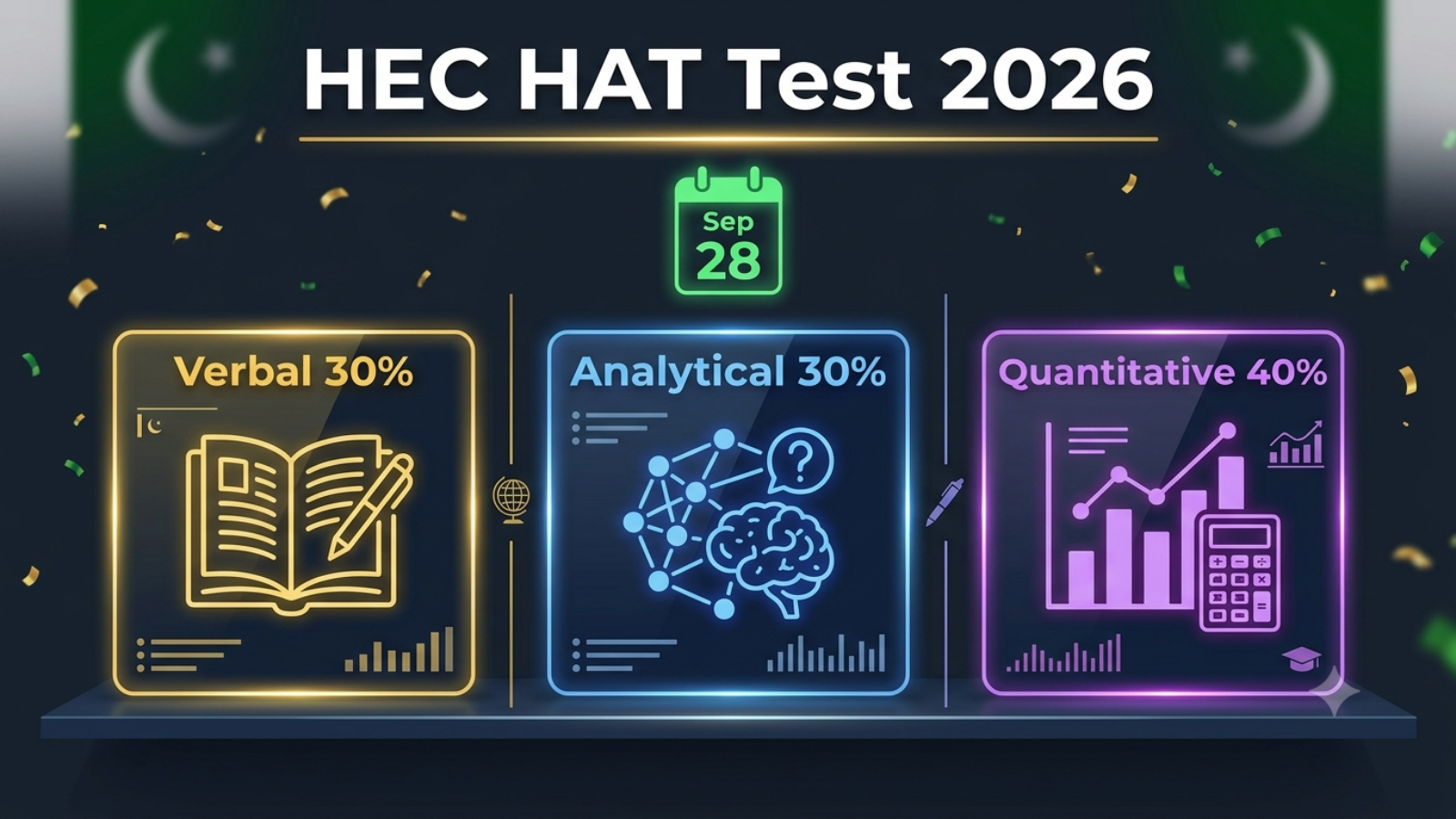
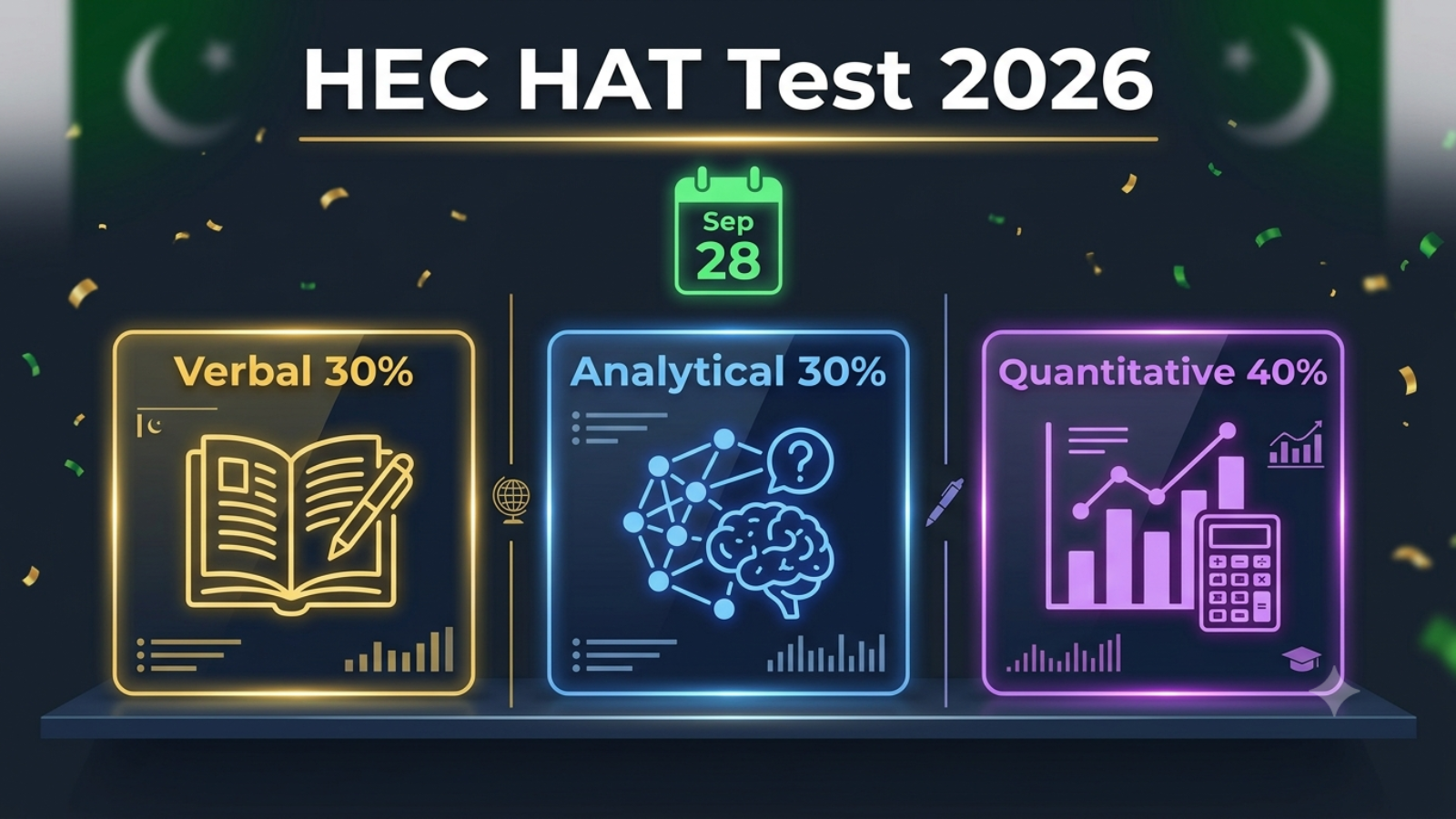
For HAT-1, the breakdown is: English/Verbal Reasoning 30%, Analytical Reasoning 30%, Quantitative Reasoning 40%, total 100%. HEC
If you studied Computer Science, Engineering, IT, Mathematics, Statistics, or Physics at Bachelor’s level, you need HAT-1. This is the category for HEC scholarships in Cybersecurity, Software Engineering, Computer Science, and all STEM fields.
Notice that for HAT-1, Quantitative Reasoning carries the highest weight at 40%. Most CS and Engineering students underestimate Verbal at 30% and lose critical marks there. In a 100-question paper, Verbal is worth 30 questions — dropping from 25/30 to 18/30 costs you 7 marks which can be the difference between a 72 and a 65.
Who Is Eligible for HAT Test 2026?
Those applicants who are interested in getting admission to MS/MPhil programmes in private and public universities of Pakistan, and those who intend to apply for scholarship schemes to be advertised by HEC, are eligible. The candidates who have completed 16 years of education or equivalent are eligible to apply. Ilmkidunya
In practical terms: if you have a 16-year Bachelor’s degree (BS, B.Com, BBA, B.Sc., B.E.) from any HEC-recognized institution, you are eligible to appear in HAT. There is no age limit for most programs, and there is no limit on the number of times you can appear.
Candidates applying for MS, MPhil, and PhD programmes, or those applying for HEC scholarships, are eligible. The score remains valid for two years. Gotest
This two-year validity is important. HEC will consider the best HAT score of the last two years for shortlisting purposes. So if you appear in July 2026 and September 2026, HEC uses whichever score is higher when evaluating your scholarship application. HEC
HAT Test Fee and Registration Process 2026
The fee for the HAT test is Rs. 2,000. This is one of the most affordable standardized tests in Pakistan — far cheaper than GRE, GMAT, or IELTS. Ilmkidunya
Here is the complete registration process:
Step 1. Visit the official HEC ETC portal: etc.hec.gov.pk
Step 2. Create your account using your CNIC number and a valid email address. Use an email you check daily — all communications including roll number slip and result are sent there.
Step 3. Complete your profile in “My Profile” section — academic history, CNIC details, contact information.
Step 4. Click on “Higher Education Aptitude Test” from the left menu panel. Select your HAT category carefully. The applicant must select the correct category on the respective online portal. If you select HAT-2 instead of HAT-1, you cannot change it after submission. HEC
Step 5. Choose your preferred test city. Test centres are subject to changes if fewer than 250 candidates choose a centre. Select a major city — Lahore, Karachi, Islamabad, Peshawar, Quetta, Multan — to guarantee your centre is not relocated. Gotest
Step 6. Pay the Rs. 2,000 fee through the online payment options available on the portal.
Step 7. Submit your application. Only submitted applications will be considered for HAT. Saving a draft is not sufficient — you must click the final Submit button. Ilmkidunya
Step 8. Download your roll number slip from etc.hec.gov.pk approximately 10 days before the test date. Carry it to the test centre along with your original CNIC.
HAT-1 Syllabus 2026 — What Exactly Is Tested
This is the section most preparation books get wrong. Here is the exact official syllabus for each section of HAT-1, sourced from HEC’s own content weightage document:
Verbal Reasoning — 30 Questions (30 Marks)
This section tests your command of the English language at an advanced level. It is not basic grammar — it is graduate-level English comprehension and vocabulary.
The subtypes you will face in HAT-1 Verbal are: synonyms (choose the word most similar in meaning), antonyms (choose the word most opposite in meaning), analogies (word relationship pairs — the most neglected subtype by most students), sentence completion with one or two blanks, reading comprehension passages (typically 2 passages with 5 questions each), grammar and sentence correction, and vocabulary in context.
The single biggest mistake HAT-1 candidates make in Verbal is ignoring analogies. Analogies typically contribute 6 to 10 questions in the real paper. Most preparation books have very few analogy questions. This creates a massive preparation gap. Students who practice analogies systematically gain 5 to 7 marks that their competition misses.
For reading comprehension, speed is the deciding factor. Practice reading academic passages and answering 5 questions in under 8 minutes. If you spend 12 minutes on one passage you will run out of time.
Analytical Reasoning — 30 Questions (30 Marks)
The HAT test syllabus includes logical reasoning as a major component. Analytical Reasoning is pure logic with no subject knowledge required. Every question is a puzzle. Educated
The three main types are: ordering games (arrange items in sequence based on given rules), grouping games (divide items into groups based on conditions), and scheduling games (assign tasks to time slots or people to positions based on rules).
Each analytical set typically has a scenario with 4 to 6 rules followed by 4 to 6 questions. In the real HAT-1 paper, there are usually 5 to 6 analytical sets per paper. You should begin your HAT preparation 30 days prior to your test. For Analytical Reasoning specifically, 30 days of daily 1-hour practice is the minimum to become genuinely fast and accurate. Earnest Prep
The Durrani HAT Prep Guide contains 25 complete analytical reasoning tests with verified answer keys — the most comprehensive real practice material available in Pakistan. Working through all 25 tests systematically is the single most effective thing you can do to boost your analytical score.
Quantitative Reasoning — 40 Questions (40 Marks)
For HAT-1, this is the biggest section with 40% weight. It covers: algebra and equations, number theory and properties, percentages and ratios, word problems (speed, distance, time, profit, loss), geometry (areas, perimeters, angles, triangles, circles), arithmetic sequences and series, basic statistics (mean, median, mode), complex numbers, and inequalities.
The difficulty level is equivalent to intermediate mathematics (FSc/A-Level) with some first-year university topics. For CS and Engineering graduates, most of these topics are already familiar. The challenge is speed and accuracy under time pressure — 40 questions in roughly 45 minutes means under 70 seconds per question.
Common high-yield topics that appear repeatedly in real HAT papers: percentage problems, ratio and proportion, algebraic inequalities, complex number arithmetic, and word problems involving age or work.
What Score Do You Need — The Honest Picture
It is important to note that merely passing this test with 50 marks does not mean success. As the competition is very high, you need to get more than 85 marks out of 100. Many preparation books available in the market are outdated or out of scope and only help in getting approximately 40 to 50 marks. Earnest Prep
This is the most important fact to absorb. The minimum passing score of 50 is irrelevant for scholarship competition. Here is what your score actually means in the context of your goals:
Score 50–59: Passes the HAT threshold. Eligible for some HEC scholarships with minimum 50% requirement (Hungary, China, Cuba, Morocco, Azerbaijan). Will struggle for admissions to top Pakistani universities where the competitive cutoff is significantly higher.
Score 60–69: Applicants are required to obtain minimum 60% marks in HAT for consideration for Commonwealth scholarship nomination. With 60–69 you meet the Commonwealth UK threshold but are at the floor of a competitive pool. HEC
Score 70–79: Candidates must have minimum 70% marks in a valid HEC Aptitude Test for HEC Overseas PhD Scholarship. At 70+ you open every major HEC scholarship program. Strong position for Hungary and China, competitive for Commonwealth. HEC
Score 80–84: Top 15–20% of all HAT candidates nationally. All major HEC scholarships accessible. Commonwealth UK nomination is realistic with a strong Statement of Purpose and confirmed supervisor.
Score 85+: Top 5–10% nationally. As the competition is very high, you need more than 85 marks to stand out for scholarship nominations. At this level, every door is open. Earnest Prep
6-Week Preparation Plan to Score 85+ in HAT-1
This plan is built specifically for HAT-1 (Computer Science, Engineering, IT) and is designed to take you from a cold start to 85+ in 42 days.
Week 1 — Diagnostic and Foundation
On day one, take a full 100-question mock test under real conditions — 120 minutes, no breaks, no phone. Score yourself honestly section by section. This diagnostic tells you exactly where to focus. Most CS graduates find Verbal is their weakest section and Quantitative is their strongest. Analytical is usually mid-range.
Spend 60% of week 1 on Verbal foundations. Learn 20 new vocabulary words daily from a GRE word list (download any free GRE vocabulary PDF — GRE Magoosh 1000 words or Barron’s 800 words are both excellent). Focus on antonyms, synonyms, and analogy patterns. These three subtypes make up roughly 50% of the Verbal section.
Week 2 — Verbal Intensive
Do 30 Verbal questions every day. Mix all subtypes — synonyms, antonyms, analogies, fill-in-the-blank, grammar. Time yourself — 30 questions should take no more than 28 minutes. Review every wrong answer and understand why the correct answer is correct. Do not just memorize the answer — understand the reasoning.
Practice reading comprehension daily. Read one academic passage and answer 5 comprehension questions in 8 minutes. Use any English newspaper editorial (Dawn, The News) for practice material. Academic English reading speed is a skill that only builds with daily repetition.
Week 3 — Analytical Reasoning
Dedicate week 3 entirely to Analytical Reasoning. Work through 2 complete analytical test sets per day from the Durrani HAT Prep Guide. Do not look at answers until you have fully attempted every question in the set. After checking, study every wrong answer and trace back exactly which rule you misread or misapplied.
The most common analytical reasoning mistakes are: misreading “immediately before” as “before” (they are different), confusing “cannot be” with “must be,” and failing to make a constraint diagram before answering questions. Draw a simple diagram for every analytical set — this alone saves 3 to 5 marks per paper.
Week 4 — Quantitative Reasoning
Work through HAT-1 Quantitative topics systematically. Spend 2 days each on: percentages and ratios, algebra and equations, word problems, geometry, and complex numbers. For each topic, do 15 to 20 questions timed. Target 40 Quantitative questions in 38 minutes — that is the pace you need for HAT-1.
Pay special attention to word problems. They appear in every single HAT paper and account for 8 to 12 questions. Common formats: two people working at different speeds completing a task, profit and loss calculations, distance-rate-time problems, mixture problems.
Week 5 — Full Mock Tests and Weak Area Attack
Take one complete 100-question timed mock test every 2 days. After each test, calculate your section-wise score. Identify the weakest 2 to 3 question types in each section and spend focused time on those specific types.
By week 5, your score should be in the 72 to 80 range if you followed the plan. The jump from 75 to 85 happens in this week through drilling your specific weak spots relentlessly.
Week 6 — Consolidation and Exam Technique
No new content in week 6. Only revision and timed practice. Take one full mock test at the start and one at the end of the week to measure your final level. Practice the specific exam technique: in the real HAT, do Quantitative first (your strongest, build confidence), then Analytical, then Verbal last. This order maximizes marks because you are freshest when doing the highest-weight section.
The night before the test, do not study. Sleep 8 hours. Bring your CNIC, roll number slip, two pens, and a pencil. Arrive at the test centre 30 minutes early.
Top 10 Universities in Pakistan That Require HAT for MS Admission
Every top Pakistani university either requires HAT or accepts it in place of their own entry test. Here are the ten most competitive:
NUST (National University of Sciences and Technology) — One of Pakistan’s highest-ranked universities for CS and Engineering. Accepts HAT for MS/MPhil admissions. Very high competitive cutoff.
COMSATS University Islamabad — Accepts HAT for all MS programs across all campuses. One of the most HAT-friendly universities in Pakistan for CS and IT graduates.
QAU (Quaid-i-Azam University) Islamabad — HAT required for all MS/MPhil programs. Strong research programs in Computer Science.
UET Lahore (University of Engineering and Technology) — Accepts HAT for MS admission in Engineering and Technology disciplines.
LUMS (Lahore University of Management Sciences) — Accepts HAT as one of the admission test options for select programs.
NED University Karachi — HAT accepted for MS Engineering programs.
University of Peshawar — HAT required for all MS/MPhil programs under HEC guidelines.
Bahauddin Zakariya University Multan — HAT accepted for MS admissions across all disciplines.
University of Agriculture Faisalabad — HAT required for MS programs in agriculture and related sciences.
Government College University Lahore — HAT accepted for MS programs in Sciences, Humanities, and Social Sciences.
HAT vs GAT — What Is the Difference?
This is one of the most frequently asked questions by Pakistani students. Here is the precise difference:
HAT (Higher Education Aptitude Test) is conducted by HEC through ETC. It is required for MS/MPhil/PhD admissions and for all HEC scholarships — both domestic and foreign. The HAT is a general aptitude test covering Verbal, Analytical, and Quantitative reasoning. It has four categories for different discipline groups.
GAT-General is conducted by the National Testing Service (NTS). It is required by some universities independently of HEC requirements. GAT-General test conducted by NTS is not applicable for HEC scholarships. Only HAT test conducted by HEC is applicable for scholarship nominations. HEC
GAT-Subject is also conducted by NTS and is discipline-specific — it tests knowledge in your specific field (CS, Engineering, etc.). The HEC Overseas PhD Scholarship requires both HAT (general aptitude) and GAT-Subject (discipline knowledge).
In summary: for HEC scholarships, you need HAT. For HEC Overseas PhD specifically, you also need GAT-Subject. For university admissions, check the specific university’s requirement — some ask for HAT, some for GAT-General, and some accept either.
Common Mistakes That Cost Pakistani Students 15+ Marks in HAT
Based on the pattern of real HAT papers and official HEC content weightages, here are the most expensive mistakes candidates consistently make:
Mistake 1 — Ignoring Analogies. Most students skip analogy preparation because their preparation books have very few analogy questions. But analogies appear in every real HAT verbal section and cost students 5 to 8 marks. Practice at least 50 analogy questions before your test.
Mistake 2 — Not drawing constraint diagrams in Analytical. Students who mentally track analytical rules without writing them down make significantly more errors and take much longer per question. Always draw a quick diagram — even a simple table or list — for every analytical scenario.
Mistake 3 — Rushing Quantitative and making calculation errors. For HAT-1, Quantitative is 40 marks. A careless arithmetic error in a word problem costs 1 mark that took 60 seconds of work to set up. Write your working clearly and re-read the question before marking your final answer.
Mistake 4 — Spending too long on a single question. In a 120-minute paper with 100 questions, you have 72 seconds average per question. If a question is taking more than 90 seconds, skip it, mark it, and return later. Never let one hard question ruin five easy ones.
Mistake 5 — Using outdated preparation books. Many preparation books available in the market are outdated or out of scope. These books only help in getting approximately 40 to 50 marks. Always prepare from official HEC sample papers and verified past paper question banks. Earnest Prep
Mistake 6 — Not attempting all questions. With no negative marking, every unanswered question is a free mark you are throwing away. If you have 5 minutes left and 8 questions unanswered, guess all 8. Statistically you will get 1 to 2 correct just from guessing — that is 1 to 2 marks for zero effort.
HAT Test Day — Complete Checklist
The night before:
Print or save your roll number slip digitally
Charge your phone
Prepare your CNIC (original — photocopy not accepted)
Pack two pens and two pencils
Sleep 8 hours minimum — cognitive performance drops 20% with less than 7 hours of sleep
Test day morning:
Eat a proper breakfast — glucose is brain fuel
Arrive 30 minutes before your reporting time
Do not study — light review only, nothing new
Keep water with you if permitted at your centre
During the test:
Read every question carefully before selecting your answer
Attempt Quantitative first, then Analytical, then Verbal — highest weight sections while freshest
Never leave any question unanswered — guess if necessary
Watch your time: 40 minutes for Quantitative, 35 minutes for Analytical, 35 minutes for Verbal, 10 minutes for review
Frequently Asked Questions — HEC HAT Test 2026
Q: When is the next HAT test after July 2026? The HAT test will be conducted nationwide on Sunday, September 28, 2026. The last date for online registration is Tuesday, September 9, 2026. Gotest
Q: What is the HAT test fee in 2026? The fee for HAT test is Rs. 2,000. Ilmkidunya
Q: How many times can I appear in HAT? There is no limit on attempts. You can appear in every HAT cycle. HEC uses your best score from the last two years for scholarship shortlisting.
Q: Is HAT compulsory for MS admission in Pakistan? Yes. HAT is mandatory for students seeking admission in MPhil/MS and PhD programmes in Pakistani universities as well as for availing HEC scholarships. All HEC-recognized universities follow this requirement. Gotest
Q: What is the passing score for HAT 2026? The minimum passing score is 50 out of 100. However, for competitive scholarship nominations you need 75+, and for top-level competition 85+.
Q: Can I use HAT score for Commonwealth scholarship? Yes. Applicant must have obtained a minimum score of 60 out of 100 in HAT test for consideration towards Commonwealth scholarship nomination. HEC
Q: Which HAT category is for Computer Science? HAT-1 is for Engineering and Technology, Computer Science, Mathematics, Statistics, and Physics. HEC
Q: Is there negative marking in HAT? There is no negative marking in HAT. You can attempt the full paper within the allowed time. Educated
Q: How long is the HAT score valid? The score remains valid for a period of two years. Gotest
Q: Where do I register for HAT 2026? Register online at etc.hec.gov.pk. In case of any issue during online registration, visit onlinehelp.hec.gov.pk or visit your nearest HEC regional office.
Start Your HAT Preparation Right Now
The September 28 test is 12 weeks away from the July 5 test. That is enough time to go from 60 to 85+ if you prepare correctly with the right material.
Practice free with 474 real HAT MCQs extracted directly from the Durrani HAT Preparation Guide and the HEC official sample paper — covering all three sections (Verbal, Quantitative, and Analytical) with full answer explanations:
Your HAT score for HEC scholarship 2026 is not just a number. It is the single most important gate between you and a fully funded master’s or PhD degree abroad — in the UK, Hungary, China, Germany, or elsewhere. Every foreign scholarship program processed through HEC has a minimum HAT score requirement, and your score directly determines whether HEC even submits your name to the partner country.
This article breaks down exactly which scholarships need what HAT score, what each program offers, how the selection process really works, and what you must do right now after receiving your July 2026 HAT result.
Why Your HAT Score Controls Your Scholarship Application
Most Pakistani students think the scholarship application process starts after they pass the HAT test. That is wrong. Under the Learning Opportunities Abroad (LOA) framework, HEC accepts a valid HAT score as the mandatory pre-screening filter for all Master’s and PhD programs. Applicants for the Hungarian, Commonwealth, and Chinese Government scholarship programs are advised to obtain a valid HAT score before applying on the LOA portal. HEC
This means HEC does not even forward your application to the scholarship partner — whether that is the UK Commonwealth Scholarship Commission, the Hungarian Tempus Foundation, or the China Scholarship Council — unless your HAT score meets their threshold. HEC’s HAT score requirement serves as a pre-screening filter. Only candidates who meet the HAT threshold are submitted to partner programs. Scholarsfunds
Passing HAT with 50 marks is not enough to be competitive. As the competition is very high, you need to get more than 85 marks out of 100 to be seriously competitive for scholarship nominations. Many preparation books in the market only help students achieve 40 to 50 marks. Earnest Prep
Understanding this reality is why your HAT score matters far beyond just clearing the minimum.
Complete Breakdown — HAT Score Required for Each HEC Scholarship 2026
Here is every major HEC-processed foreign scholarship program with the exact HAT score requirement confirmed from official HEC sources:
Scholarship Program
Country
Level
Minimum HAT Score
Competitive Score
Commonwealth Scholarship
UK
MS / PhD
60 out of 100
80+
Stipendium Hungaricum
Hungary
MS / PhD
50 out of 100
70+
Chinese Government Scholarship (CSC)
China
MS / PhD
50 out of 100
70+
HEC Overseas PhD Phase-II
UK/USA/Europe/Australia
PhD only
70 out of 100
80+
Moroccan Government Scholarship
Morocco
MS / PhD
50 out of 100
65+
Azerbaijan Government Scholarship
Azerbaijan
MS / PhD
50 out of 100
65+
Cuban Government Scholarship
Cuba
MS / PhD
50 out of 100
60+
The “minimum” score gets your application processed. The “competitive” score gets you actually nominated and sent to the partner country.
1. Commonwealth Scholarship 2026 — UK (HAT 60+ Required)
The Commonwealth Scholarship is one of the most prestigious fully funded scholarships available to Pakistani students. To qualify, applicants must hold a first division in their 16-year Bachelor’s or Master’s degree, must not have a second or third division in their terminal degree, and must obtain a minimum score of 60 out of 100 in the HAT test. IELTS is not required by HEC — though individual UK universities may have their own English requirements. HEC
What the scholarship covers: full tuition, monthly living allowance, return airfare, and arrival allowance in the UK.
The selection process involves initial screening by HEC for academic records and HAT scores, followed by forwarding of eligible applications to the Commonwealth Scholarship Commission in the UK. A confirmed supervisor at a UK university increases your chances of nomination significantly. ACAD
The Commonwealth Scholarship application deadline was recently extended. HEC officially extended the deadline for Commonwealth Scholarships, with both the HEC e-portal and the CSC portal applications due by October 21, 2026. Applicants must submit two separate online applications — one on the CSC UK portal and another on the HEC e-portal. ACAD
HAT score needed to be competitive: 75 or above. With 60 you are eligible. With 75 you are competitive. With 80+ you are in a strong position.
The Stipendium Hungaricum is Hungary’s flagship scholarship program and one of the most accessible fully funded scholarships for Pakistani students because of its relatively lower HAT threshold. Without providing a minimum HAT score of 50 out of 100, applications will not be considered for further processing. The test score is automatically updated for scholarship nominations after results are announced — applicants do not need to add their marks manually. HEC
What the scholarship covers: full tuition waiver, monthly stipend, accommodation, and health insurance for study at Hungarian universities.
In case of final selection, applicants must sign a bond on legal/stamp paper committing to return to Pakistan and serve the country for a period as prescribed by HEC immediately after completing their degree. HEC
The GAT-General test conducted by NTS is not acceptable for this scholarship. Only the HAT test conducted by HEC is valid. HEC
HAT score needed to be competitive: 65 or above. This is the most accessible route to a fully funded European degree for students with a moderate HAT score.
3. Chinese Government Scholarship (CSC) 2026 — China (HAT 50+ Required)
The CSC scholarship through HEC requires HAT for MS and PhD programs. The passing marks for the HAT test are 50 out of 100 for this program. China has one of the highest numbers of scholarship seats available to Pakistani students annually through HEC. The scholarship covers full tuition, accommodation on campus, and a monthly stipend ranging from 3,000 to 3,500 RMB depending on the study level. GradWinner
Many CSC seats for Pakistan are processed via HEC. Applications for the Chinese Government Scholarship typically open between November and January. Velocitytv
Top Chinese universities for Computer Science and Cybersecurity under CSC include Tsinghua University, Peking University, Shanghai Jiao Tong University, and Zhejiang University — all ranked in the top 100 globally for Engineering and IT.
HAT score needed to be competitive: 65 or above for general universities. 75+ for top-tier universities like Tsinghua or Peking.
Apply at: scholarship.hec.gov.pk → Learning Opportunities Abroad → Chinese Government Scholarship
This is HEC’s own flagship PhD program that sends Pakistani scholars to world-ranked universities in the UK, USA, Europe, China, and Australia. Eligibility requires an MPhil or equivalent degree, minimum 3.0 CGPA, GAT-Subject 70+ percentile, age below 35, and a faculty or university nomination. This scholarship requires candidates to be working as a lecturer or researcher at an HEC-recognized institution in Pakistan. INFO
Candidates must have a minimum of 70% marks in a valid HEC Aptitude Test (HAT). HEC will consider the best HAT score from the last two years for shortlisting purposes. HEC
For the HEC Overseas PhD, selection is based on HAT score, GAT-Subject percentile, academic CGPA, quality of the research proposal, institutional nomination, and interview performance if shortlisted. What separates shortlisted applicants from rejected ones is proposal quality combined with credible institutional backing. Scholarsfunds
Important: If you are a fresh graduate and not currently employed as a lecturer at a Pakistani university, this specific program is not accessible to you. Look at the Commonwealth, CSC, or Stipendium Hungaricum routes instead.
HAT score needed: 70 is the minimum. 80+ makes you genuinely competitive.
5. Moroccan, Azerbaijani, and Cuban Government Scholarships (HAT 50+ Required)
These are less-known but very real fully funded opportunities available through HEC LOA. All applicants for foreign-funded scholarship programs are required to obtain a minimum score of 50% in HAT or USAT. Iba
Morocco offers fully funded scholarships at Hassan II University of Casablanca and Mohammed V University in French and Arabic-medium programs. Azerbaijan offers scholarships at Baku State University and Azerbaijan Technical University. Cuba offers medical and science scholarships at University of Havana.
These programs have significantly lower competition compared to UK or China routes, making them viable options for students with HAT scores in the 55–65 range who want to study abroad on a full scholarship.
How the HEC Scholarship Selection Process Actually Works
Understanding the process end to end prevents the most common mistakes Pakistani applicants make.
Stage 1 — HAT Score Verification. You appear in HAT and receive your result. Your score is automatically linked to your CNIC in the HEC database. You do not need to manually upload it for most programs — it is pulled directly.
Stage 2 — Application on HEC LOA Portal. You apply at scholarship.hec.gov.pk under Learning Opportunities Abroad. You select your target scholarship program and fill in academic details, upload documents, and submit your Statement of Purpose.
Stage 3 — HEC Pre-Screening. HEC filters all applications based on HAT score threshold, CGPA, degree completion, and document completeness. Applications below the minimum HAT score are rejected at this stage without being forwarded.
Stage 4 — Merit Ranking. Among those who clear the HAT threshold, HEC ranks candidates by a combination of HAT score, CGPA, and program-specific criteria. Merit is strictly based on HAT score for most HEC scholarship programs. HEC reserves the right to modify the selection criteria. Iba
Stage 5 — Nomination to Partner Program. HEC forwards the top-ranked candidates to the partner country’s scholarship body — CSC for China, Tempus for Hungary, CSC UK for Commonwealth. The partner then makes the final award decision based on their own criteria including research proposal, academic fit, and available seats.
Stage 6 — Bond Signing. Successful candidates sign a legal bond with HEC committing to return to Pakistan and serve the country for a period equal to the scholarship duration. This is mandatory for all HEC-processed foreign scholarships.
What HAT Score Do You Actually Need in 2026 to Win a Scholarship?
Let us be completely honest about this. The minimum score and the competitive score are very different numbers.
Passing with 50 marks does not mean success. Competition is very high and you realistically need more than 85 marks to stand out at the national level for scholarship nominations. Earnest Prep
Here is a practical score-to-scholarship guide based on real 2026 data:
HAT Score 50–59 — Eligible for Stipendium Hungaricum, CSC China, Morocco, Azerbaijan, Cuba. These programs have lower competition. Your chances are real if your CGPA is strong (3.0 or above) and your Statement of Purpose is excellent.
HAT Score 60–69 — Add Commonwealth UK to the list. You meet the minimum for the most prestigious HEC scholarship. However, with 60 you are at the floor of a very competitive pool. Strengthen your application with a confirmed UK supervisor and a strong research proposal.
HAT Score 70–79 — Opens the HEC Overseas PhD. You are now competitive for all major programs. Focus your energy on the Commonwealth and CSC China routes where 70+ puts you in a genuinely strong position.
HAT Score 80–84 — Top tier. You are among the strongest candidates nationally. Apply for Commonwealth, CSC China, Stipendium Hungaricum simultaneously. All three are realistic.
HAT Score 85+ — National top performer. You are in the top bracket. Every HEC scholarship program is accessible to you. Focus on the Commonwealth UK or HEC Overseas PhD for the most prestigious outcome.
Documents Required for HEC Scholarship Applications 2026
Regardless of which program you apply for, have these documents ready before the portal opens:
All degree certificates and transcripts (attested by HEC where required), CNIC copy, passport copy (valid for at least 2 years beyond your program end date), HAT scorecard, two strong recommendation letters from university professors, a Statement of Purpose (500–1000 words), a research proposal for PhD programs (2000–3000 words), English Medium Certificate from your previous institution if IELTS is not available, photograph on white background, medical fitness certificate (required for Hungarian scholarship), and domicile certificate.
Do not wait until applications open to collect these. Several documents — especially the English Medium Certificate, attested transcripts, and recommendation letters — take weeks to obtain. Start now.
How to Improve Your HAT Score for the Next Cycle
If your July 2026 HAT score did not reach the level you needed for your target scholarship, the September 2026 HAT test is your next opportunity. HEC considers the best HAT score from the last two years for shortlisting purposes. This means if you scored 68 in July and then score 78 in September, HEC will use 78 for your scholarship application. HEC
The most common reason candidates score below 70 is poor preparation strategy, not lack of ability. Most preparation books on the market are designed for passing, not for scoring 80+. Real past paper questions are the only reliable preparation material.
To genuinely push your score from 60 to 80, you need to:
Practice all 25 analytical reasoning tests from the Durrani HAT Prep Guide systematically — not randomly. Work through them in order, understand the logic rules for each scenario, and review every wrong answer before moving on. Analytical reasoning is the section where disciplined practice produces the fastest score improvement.
For Verbal Reasoning — which carries 50 marks — build vocabulary daily using GRE-level word lists. Learn 20 new words every day for 6 weeks. Focus specifically on antonyms, analogies, and sentence completion — these three subtypes appear most frequently in real HAT papers.
For Quantitative Reasoning — timed practice is everything. The questions are not difficult but 30 questions in limited time creates pressure. Do timed sets of 10 questions in 12 minutes until the pace feels natural.
Practice free with 474 real HAT MCQs from the Durrani PDF and HEC official sample paper:
👉 Free HAT Practice — 474 Real Questions: syedaounraza.online/hec-hat-test-preparation-2026/
Timeline — What to Do Right Now After Your July 2026 HAT Result
If your result is announced in August 2026:
August 2026 — Check your result at etc.hec.gov.pk. Identify your score and which scholarships you are eligible for. Begin collecting all required documents immediately.
August–September 2026 — Commonwealth Scholarship portal typically opens in August–September for the next cycle. If your score is 60+, apply immediately. Do not wait.
September–October 2026 — If your score was below your target, appear in the September 2026 HAT test. Prepare intensively for 6 weeks.
October 2026 — Commonwealth Scholarship 2026 application deadline is October 21, 2026 on both the HEC e-portal and the CSC UK portal.
November–January 2027 — CSC China and Stipendium Hungaricum applications typically open for the 2027–28 academic year. Begin preparing research proposals and contacting supervisors now.
Frequently Asked Questions — HAT Score and HEC Scholarships 2026
Q: What is the minimum HAT score for HEC scholarship? The minimum varies by program. Commonwealth UK requires 60. Stipendium Hungaricum and CSC China require 50. HEC Overseas PhD requires 70. To be genuinely competitive, aim for 80+.
Q: Is HAT score the only factor for HEC scholarship selection? No. For HEC scholarships, selection is based on HAT score, CGPA, quality of the research proposal, institutional nomination where applicable, and interview performance if shortlisted. Scholarsfunds
Q: Can I apply for multiple HEC scholarships with one HAT score? Yes. One valid HAT score (from the last 2 years) can be used to apply for all LOA programs simultaneously. You cannot receive two government scholarships at the same time, but you can apply for multiple programs and accept whichever you are awarded.
Q: Does HEC require IELTS for scholarship applications? HEC does not require IELTS score for scholarship applications. However, the applicant may need to fulfil the individual university’s English requirement. An English Medium Certificate from your previous institution is accepted as an alternative by HEC. HEC
Q: My CGPA is 3.17. Am I eligible? Yes. Most HEC LOA scholarship programs require a minimum CGPA of 3.0. A 3.17 CGPA meets the eligibility threshold for Commonwealth, CSC China, and Stipendium Hungaricum. Your HAT score and Statement of Purpose will be the deciding factors.
Q: How long is my HAT score valid for scholarship applications? HEC considers the best HAT score from the last two years for shortlisting purposes. Your July 2026 score is valid until July 2028. HEC
Q: Where do I apply for HEC foreign scholarships? Apply at scholarship.hec.gov.pk under the Learning Opportunities Abroad section.
Useful Official Links
HEC Scholarship Portal: scholarship.hec.gov.pk
HEC ETC Portal (HAT Result & Registration): etc.hec.gov.pk