Quick answer: HEC has officially released the HAT-MS answer key for the test held on July 4 & 5, 2026. You can download it directly from HEC’s official announcements page, organized by category and booklet color (Blue, Green, Pink, White, Yellow). Match your booklet color to the correct PDF to calculate your expected score before the official result.
If you sat the HAT-MS test on July 4 or 5, this is the update you’ve been refreshing your browser for. Here’s exactly how to find your key, use it correctly, and what happens next.
Where to Download the HAT Answer Key
HEC publishes answer keys through its official announcements page, not through a general Google search result — always go straight to the source to avoid outdated or incorrect keys circulating on unofficial pages. The official HEC announcement for this test lists separate PDF files for each category and booklet color combination.
How to Find Your Specific Key
HAT-MS was administered across five categories, and within each category, question booklets were distributed in five different colors to prevent copying between adjacent test-takers. That means you need to match both your category and your booklet color exactly — using the wrong color key will give you a completely inaccurate score estimate.
Steps to download:
Check your admit card or booklet cover for your exact category (General, or Category I, II, III, etc.)
Check the top corner of your question booklet for the color — it’s printed clearly on the cover
Go to the official HEC announcement page linked above
Find the file matching your category and color exactly (files are named clearly, e.g., “HAT-MS-GENERAL-AnswerKey-White”)
Download and open the PDF
How to Calculate Your Expected Score
Once you have the correct key, go through your recorded answers question by question. HAT scoring typically awards one mark per correct answer with no negative marking for incorrect ones — so there’s no penalty for guessing, which means a slightly lower calculated score from the key is still worth taking seriously if you left several answers blank.
Add up your correct answers, then compare that number against previous test cycles’ cutoffs for your category if you want a rough sense of where you stand — though HEC determines the actual passing threshold after each test cycle, so treat this as an estimate, not a guarantee.
What Happens After the Answer Key
The answer key isn’t your final result — it’s a self-assessment tool released ahead of the official scorecard. Based on HEC’s typical timeline for HAT test cycles, official results are usually published on the ETC portal within a few weeks of the answer key release. Once available, you’ll check your actual result using your CNIC or roll number on the ETC portal, not through the answer key page.
What If You Think a Question Was Wrongly Keyed
If you believe a specific answer in the key is incorrect, HEC does not typically offer a rechecking or challenge facility for HAT the way some other standardized tests do. Your best move is to double check the question against your booklet carefully first — a mismatch is often a booklet-color mix-up rather than an actual keying error.
Frequently Asked Questions
When was the HAT-MS test this key applies to held? July 4 and 5, 2026, across five categories.
How do I know which booklet color I had? It’s printed on the cover of your question booklet, along with your category. Check your admit card if you’re unsure.
Is there negative marking on the HAT test? No — HAT scoring awards marks for correct answers only, with no deduction for incorrect ones.
When will the official HAT result be announced? HEC typically releases official results a few weeks after the answer key, through the ETC portal using your CNIC or roll number.
Can I request a recheck if I disagree with the answer key? HEC does not generally offer a rechecking facility for HAT. Double-check your booklet color and category match before assuming a keying error.
Where can I prepare for a future HAT test if I need to retake it? See our full HAT test preparation guide for study resources and test structure.
The HEC HAT test 2026 is the single most important exam a Pakistani CS, Engineering, or IT graduate will appear in this year. It controls MS and MPhil admissions at every top Pakistani university, and it is the mandatory gateway for every HEC foreign scholarship — Commonwealth UK, Stipendium Hungaricum Hungary, Chinese Government Scholarship, and more. Whether you appeared in the July 5 test, are waiting for your result, or planning to appear in the September 28 cycle, this is the only guide you need.
Everything in this article comes from official HEC and ETC sources — no guessing, no outdated information.
What Is the HEC HAT Test?
The HEC HAT test is designed on the pattern of international testing standards of Verbal Reasoning, Analytical Reasoning, and Quantitative Reasoning. HEC started this service in 2017 to provide a well-managed and unbiased testing platform for admissions on merit basis. Gotest
The full name is Higher Education Aptitude Test, and it is conducted by the Education Testing Council (ETC) under the Higher Education Commission of Pakistan. HAT is an eligibility test conducted by HEC through ETC for the award of all HEC scholarships and for admission to MS and MPhil programmes. Ilmkidunya
The marks for the HAT test are 100 and the time permitted is two hours. The pattern of the paper is based on MCQs and the test is not negatively marked. This last point matters enormously — with no negative marking, you should attempt every single question even if you are guessing. Educated
HAT Test 2026 — Complete Schedule (All Cycles)
HEC conducts HAT almost once every two months. HAT test schedule for 2026 has five test dates. Here is the verified full 2026 calendar: Earnest Prep
HAT Cycle
Registration Deadline
Test Date
Result Expected
HAT January 2026
Mid-January 2026
January 2026
February 2026
HAT April 2026
March 30, 2026
April 19, 2026
May 8, 2026
HAT July 2026
June 2026
July 5, 2026
August 1, 2026
HAT September 2026
September 9, 2026
September 28, 2026
October 2026
HAT December 2026
November 2026
December 2026
January 2027
The last date for online registration for the September cycle is Tuesday, September 9, 2026, while the HAT test will be conducted nationwide on Sunday, September 28, 2026. Gotest
If you missed the July 5 test or want to improve your score, September 9 is your registration deadline. Register immediately at etc.hec.gov.pk — the portal gets overwhelmed in the final days before the deadline and late registrations are never entertained.
HAT Test Categories — Which One Do You Need?
This is where many students make a critical mistake. There are four main HAT categories and each has a different section weightage. The test will be conducted in the following five categories based on 16 years or equivalent education, and students should register accordingly. HEC
Arts, Humanities, Social Sciences, Psychology, Law
40%
35%
25%
HAT-4
Agriculture, Veterinary, Biological, Medical Sciences
40%
30%
30%
HAT-General
Religious Sciences and other disciplines
Varies
Varies
Varies
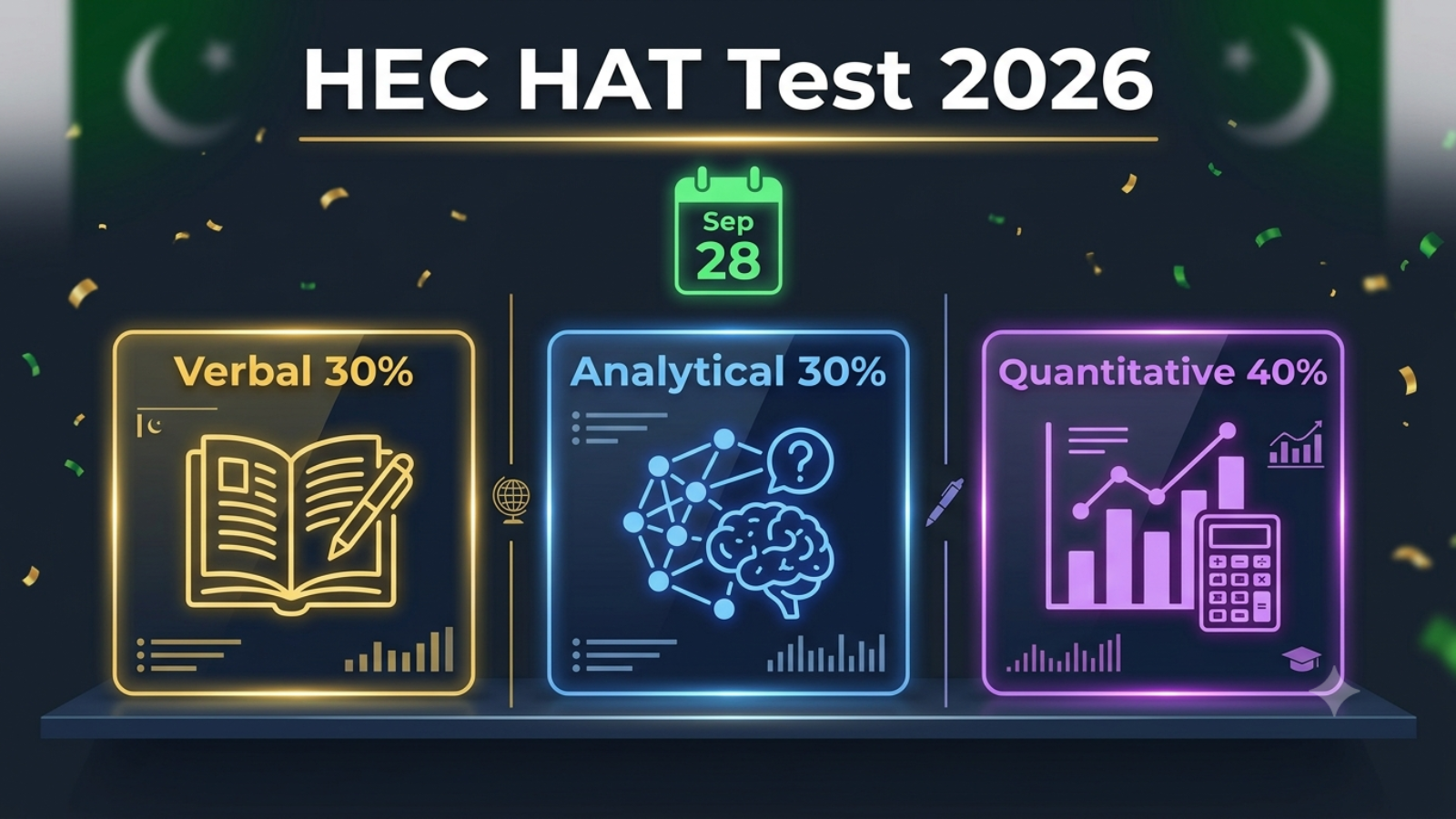
For HAT-1, the breakdown is: English/Verbal Reasoning 30%, Analytical Reasoning 30%, Quantitative Reasoning 40%, total 100%. HEC
If you studied Computer Science, Engineering, IT, Mathematics, Statistics, or Physics at Bachelor’s level, you need HAT-1. This is the category for HEC scholarships in Cybersecurity, Software Engineering, Computer Science, and all STEM fields.
Notice that for HAT-1, Quantitative Reasoning carries the highest weight at 40%. Most CS and Engineering students underestimate Verbal at 30% and lose critical marks there. In a 100-question paper, Verbal is worth 30 questions — dropping from 25/30 to 18/30 costs you 7 marks which can be the difference between a 72 and a 65.
Who Is Eligible for HAT Test 2026?
Those applicants who are interested in getting admission to MS/MPhil programmes in private and public universities of Pakistan, and those who intend to apply for scholarship schemes to be advertised by HEC, are eligible. The candidates who have completed 16 years of education or equivalent are eligible to apply. Ilmkidunya
In practical terms: if you have a 16-year Bachelor’s degree (BS, B.Com, BBA, B.Sc., B.E.) from any HEC-recognized institution, you are eligible to appear in HAT. There is no age limit for most programs, and there is no limit on the number of times you can appear.
Candidates applying for MS, MPhil, and PhD programmes, or those applying for HEC scholarships, are eligible. The score remains valid for two years. Gotest
This two-year validity is important. HEC will consider the best HAT score of the last two years for shortlisting purposes. So if you appear in July 2026 and September 2026, HEC uses whichever score is higher when evaluating your scholarship application. HEC
HAT Test Fee and Registration Process 2026
The fee for the HAT test is Rs. 2,000. This is one of the most affordable standardized tests in Pakistan — far cheaper than GRE, GMAT, or IELTS. Ilmkidunya
Here is the complete registration process:
Step 1. Visit the official HEC ETC portal: etc.hec.gov.pk
Step 2. Create your account using your CNIC number and a valid email address. Use an email you check daily — all communications including roll number slip and result are sent there.
Step 3. Complete your profile in “My Profile” section — academic history, CNIC details, contact information.
Step 4. Click on “Higher Education Aptitude Test” from the left menu panel. Select your HAT category carefully. The applicant must select the correct category on the respective online portal. If you select HAT-2 instead of HAT-1, you cannot change it after submission. HEC
Step 5. Choose your preferred test city. Test centres are subject to changes if fewer than 250 candidates choose a centre. Select a major city — Lahore, Karachi, Islamabad, Peshawar, Quetta, Multan — to guarantee your centre is not relocated. Gotest
Step 6. Pay the Rs. 2,000 fee through the online payment options available on the portal.
Step 7. Submit your application. Only submitted applications will be considered for HAT. Saving a draft is not sufficient — you must click the final Submit button. Ilmkidunya
Step 8. Download your roll number slip from etc.hec.gov.pk approximately 10 days before the test date. Carry it to the test centre along with your original CNIC.
HAT-1 Syllabus 2026 — What Exactly Is Tested
This is the section most preparation books get wrong. Here is the exact official syllabus for each section of HAT-1, sourced from HEC’s own content weightage document:
Verbal Reasoning — 30 Questions (30 Marks)
This section tests your command of the English language at an advanced level. It is not basic grammar — it is graduate-level English comprehension and vocabulary.
The subtypes you will face in HAT-1 Verbal are: synonyms (choose the word most similar in meaning), antonyms (choose the word most opposite in meaning), analogies (word relationship pairs — the most neglected subtype by most students), sentence completion with one or two blanks, reading comprehension passages (typically 2 passages with 5 questions each), grammar and sentence correction, and vocabulary in context.
The single biggest mistake HAT-1 candidates make in Verbal is ignoring analogies. Analogies typically contribute 6 to 10 questions in the real paper. Most preparation books have very few analogy questions. This creates a massive preparation gap. Students who practice analogies systematically gain 5 to 7 marks that their competition misses.
For reading comprehension, speed is the deciding factor. Practice reading academic passages and answering 5 questions in under 8 minutes. If you spend 12 minutes on one passage you will run out of time.
Analytical Reasoning — 30 Questions (30 Marks)
The HAT test syllabus includes logical reasoning as a major component. Analytical Reasoning is pure logic with no subject knowledge required. Every question is a puzzle. Educated
The three main types are: ordering games (arrange items in sequence based on given rules), grouping games (divide items into groups based on conditions), and scheduling games (assign tasks to time slots or people to positions based on rules).
Each analytical set typically has a scenario with 4 to 6 rules followed by 4 to 6 questions. In the real HAT-1 paper, there are usually 5 to 6 analytical sets per paper. You should begin your HAT preparation 30 days prior to your test. For Analytical Reasoning specifically, 30 days of daily 1-hour practice is the minimum to become genuinely fast and accurate. Earnest Prep
The Durrani HAT Prep Guide contains 25 complete analytical reasoning tests with verified answer keys — the most comprehensive real practice material available in Pakistan. Working through all 25 tests systematically is the single most effective thing you can do to boost your analytical score.
Quantitative Reasoning — 40 Questions (40 Marks)
For HAT-1, this is the biggest section with 40% weight. It covers: algebra and equations, number theory and properties, percentages and ratios, word problems (speed, distance, time, profit, loss), geometry (areas, perimeters, angles, triangles, circles), arithmetic sequences and series, basic statistics (mean, median, mode), complex numbers, and inequalities.
The difficulty level is equivalent to intermediate mathematics (FSc/A-Level) with some first-year university topics. For CS and Engineering graduates, most of these topics are already familiar. The challenge is speed and accuracy under time pressure — 40 questions in roughly 45 minutes means under 70 seconds per question.
Common high-yield topics that appear repeatedly in real HAT papers: percentage problems, ratio and proportion, algebraic inequalities, complex number arithmetic, and word problems involving age or work.
What Score Do You Need — The Honest Picture
It is important to note that merely passing this test with 50 marks does not mean success. As the competition is very high, you need to get more than 85 marks out of 100. Many preparation books available in the market are outdated or out of scope and only help in getting approximately 40 to 50 marks. Earnest Prep
This is the most important fact to absorb. The minimum passing score of 50 is irrelevant for scholarship competition. Here is what your score actually means in the context of your goals:
Score 50–59: Passes the HAT threshold. Eligible for some HEC scholarships with minimum 50% requirement (Hungary, China, Cuba, Morocco, Azerbaijan). Will struggle for admissions to top Pakistani universities where the competitive cutoff is significantly higher.
Score 60–69: Applicants are required to obtain minimum 60% marks in HAT for consideration for Commonwealth scholarship nomination. With 60–69 you meet the Commonwealth UK threshold but are at the floor of a competitive pool. HEC
Score 70–79: Candidates must have minimum 70% marks in a valid HEC Aptitude Test for HEC Overseas PhD Scholarship. At 70+ you open every major HEC scholarship program. Strong position for Hungary and China, competitive for Commonwealth. HEC
Score 80–84: Top 15–20% of all HAT candidates nationally. All major HEC scholarships accessible. Commonwealth UK nomination is realistic with a strong Statement of Purpose and confirmed supervisor.
Score 85+: Top 5–10% nationally. As the competition is very high, you need more than 85 marks to stand out for scholarship nominations. At this level, every door is open. Earnest Prep
6-Week Preparation Plan to Score 85+ in HAT-1
This plan is built specifically for HAT-1 (Computer Science, Engineering, IT) and is designed to take you from a cold start to 85+ in 42 days.
Week 1 — Diagnostic and Foundation
On day one, take a full 100-question mock test under real conditions — 120 minutes, no breaks, no phone. Score yourself honestly section by section. This diagnostic tells you exactly where to focus. Most CS graduates find Verbal is their weakest section and Quantitative is their strongest. Analytical is usually mid-range.
Spend 60% of week 1 on Verbal foundations. Learn 20 new vocabulary words daily from a GRE word list (download any free GRE vocabulary PDF — GRE Magoosh 1000 words or Barron’s 800 words are both excellent). Focus on antonyms, synonyms, and analogy patterns. These three subtypes make up roughly 50% of the Verbal section.
Week 2 — Verbal Intensive
Do 30 Verbal questions every day. Mix all subtypes — synonyms, antonyms, analogies, fill-in-the-blank, grammar. Time yourself — 30 questions should take no more than 28 minutes. Review every wrong answer and understand why the correct answer is correct. Do not just memorize the answer — understand the reasoning.
Practice reading comprehension daily. Read one academic passage and answer 5 comprehension questions in 8 minutes. Use any English newspaper editorial (Dawn, The News) for practice material. Academic English reading speed is a skill that only builds with daily repetition.
Week 3 — Analytical Reasoning
Dedicate week 3 entirely to Analytical Reasoning. Work through 2 complete analytical test sets per day from the Durrani HAT Prep Guide. Do not look at answers until you have fully attempted every question in the set. After checking, study every wrong answer and trace back exactly which rule you misread or misapplied.
The most common analytical reasoning mistakes are: misreading “immediately before” as “before” (they are different), confusing “cannot be” with “must be,” and failing to make a constraint diagram before answering questions. Draw a simple diagram for every analytical set — this alone saves 3 to 5 marks per paper.
Week 4 — Quantitative Reasoning
Work through HAT-1 Quantitative topics systematically. Spend 2 days each on: percentages and ratios, algebra and equations, word problems, geometry, and complex numbers. For each topic, do 15 to 20 questions timed. Target 40 Quantitative questions in 38 minutes — that is the pace you need for HAT-1.
Pay special attention to word problems. They appear in every single HAT paper and account for 8 to 12 questions. Common formats: two people working at different speeds completing a task, profit and loss calculations, distance-rate-time problems, mixture problems.
Week 5 — Full Mock Tests and Weak Area Attack
Take one complete 100-question timed mock test every 2 days. After each test, calculate your section-wise score. Identify the weakest 2 to 3 question types in each section and spend focused time on those specific types.
By week 5, your score should be in the 72 to 80 range if you followed the plan. The jump from 75 to 85 happens in this week through drilling your specific weak spots relentlessly.
Week 6 — Consolidation and Exam Technique
No new content in week 6. Only revision and timed practice. Take one full mock test at the start and one at the end of the week to measure your final level. Practice the specific exam technique: in the real HAT, do Quantitative first (your strongest, build confidence), then Analytical, then Verbal last. This order maximizes marks because you are freshest when doing the highest-weight section.
The night before the test, do not study. Sleep 8 hours. Bring your CNIC, roll number slip, two pens, and a pencil. Arrive at the test centre 30 minutes early.
Top 10 Universities in Pakistan That Require HAT for MS Admission
Every top Pakistani university either requires HAT or accepts it in place of their own entry test. Here are the ten most competitive:
NUST (National University of Sciences and Technology) — One of Pakistan’s highest-ranked universities for CS and Engineering. Accepts HAT for MS/MPhil admissions. Very high competitive cutoff.
COMSATS University Islamabad — Accepts HAT for all MS programs across all campuses. One of the most HAT-friendly universities in Pakistan for CS and IT graduates.
QAU (Quaid-i-Azam University) Islamabad — HAT required for all MS/MPhil programs. Strong research programs in Computer Science.
UET Lahore (University of Engineering and Technology) — Accepts HAT for MS admission in Engineering and Technology disciplines.
LUMS (Lahore University of Management Sciences) — Accepts HAT as one of the admission test options for select programs.
NED University Karachi — HAT accepted for MS Engineering programs.
University of Peshawar — HAT required for all MS/MPhil programs under HEC guidelines.
Bahauddin Zakariya University Multan — HAT accepted for MS admissions across all disciplines.
University of Agriculture Faisalabad — HAT required for MS programs in agriculture and related sciences.
Government College University Lahore — HAT accepted for MS programs in Sciences, Humanities, and Social Sciences.
HAT vs GAT — What Is the Difference?
This is one of the most frequently asked questions by Pakistani students. Here is the precise difference:
HAT (Higher Education Aptitude Test) is conducted by HEC through ETC. It is required for MS/MPhil/PhD admissions and for all HEC scholarships — both domestic and foreign. The HAT is a general aptitude test covering Verbal, Analytical, and Quantitative reasoning. It has four categories for different discipline groups.
GAT-General is conducted by the National Testing Service (NTS). It is required by some universities independently of HEC requirements. GAT-General test conducted by NTS is not applicable for HEC scholarships. Only HAT test conducted by HEC is applicable for scholarship nominations. HEC
GAT-Subject is also conducted by NTS and is discipline-specific — it tests knowledge in your specific field (CS, Engineering, etc.). The HEC Overseas PhD Scholarship requires both HAT (general aptitude) and GAT-Subject (discipline knowledge).
In summary: for HEC scholarships, you need HAT. For HEC Overseas PhD specifically, you also need GAT-Subject. For university admissions, check the specific university’s requirement — some ask for HAT, some for GAT-General, and some accept either.
Common Mistakes That Cost Pakistani Students 15+ Marks in HAT
Based on the pattern of real HAT papers and official HEC content weightages, here are the most expensive mistakes candidates consistently make:
Mistake 1 — Ignoring Analogies. Most students skip analogy preparation because their preparation books have very few analogy questions. But analogies appear in every real HAT verbal section and cost students 5 to 8 marks. Practice at least 50 analogy questions before your test.
Mistake 2 — Not drawing constraint diagrams in Analytical. Students who mentally track analytical rules without writing them down make significantly more errors and take much longer per question. Always draw a quick diagram — even a simple table or list — for every analytical scenario.
Mistake 3 — Rushing Quantitative and making calculation errors. For HAT-1, Quantitative is 40 marks. A careless arithmetic error in a word problem costs 1 mark that took 60 seconds of work to set up. Write your working clearly and re-read the question before marking your final answer.
Mistake 4 — Spending too long on a single question. In a 120-minute paper with 100 questions, you have 72 seconds average per question. If a question is taking more than 90 seconds, skip it, mark it, and return later. Never let one hard question ruin five easy ones.
Mistake 5 — Using outdated preparation books. Many preparation books available in the market are outdated or out of scope. These books only help in getting approximately 40 to 50 marks. Always prepare from official HEC sample papers and verified past paper question banks. Earnest Prep
Mistake 6 — Not attempting all questions. With no negative marking, every unanswered question is a free mark you are throwing away. If you have 5 minutes left and 8 questions unanswered, guess all 8. Statistically you will get 1 to 2 correct just from guessing — that is 1 to 2 marks for zero effort.
HAT Test Day — Complete Checklist
The night before:
Print or save your roll number slip digitally
Charge your phone
Prepare your CNIC (original — photocopy not accepted)
Pack two pens and two pencils
Sleep 8 hours minimum — cognitive performance drops 20% with less than 7 hours of sleep
Test day morning:
Eat a proper breakfast — glucose is brain fuel
Arrive 30 minutes before your reporting time
Do not study — light review only, nothing new
Keep water with you if permitted at your centre
During the test:
Read every question carefully before selecting your answer
Attempt Quantitative first, then Analytical, then Verbal — highest weight sections while freshest
Never leave any question unanswered — guess if necessary
Watch your time: 40 minutes for Quantitative, 35 minutes for Analytical, 35 minutes for Verbal, 10 minutes for review
Frequently Asked Questions — HEC HAT Test 2026
Q: When is the next HAT test after July 2026? The HAT test will be conducted nationwide on Sunday, September 28, 2026. The last date for online registration is Tuesday, September 9, 2026. Gotest
Q: What is the HAT test fee in 2026? The fee for HAT test is Rs. 2,000. Ilmkidunya
Q: How many times can I appear in HAT? There is no limit on attempts. You can appear in every HAT cycle. HEC uses your best score from the last two years for scholarship shortlisting.
Q: Is HAT compulsory for MS admission in Pakistan? Yes. HAT is mandatory for students seeking admission in MPhil/MS and PhD programmes in Pakistani universities as well as for availing HEC scholarships. All HEC-recognized universities follow this requirement. Gotest
Q: What is the passing score for HAT 2026? The minimum passing score is 50 out of 100. However, for competitive scholarship nominations you need 75+, and for top-level competition 85+.
Q: Can I use HAT score for Commonwealth scholarship? Yes. Applicant must have obtained a minimum score of 60 out of 100 in HAT test for consideration towards Commonwealth scholarship nomination. HEC
Q: Which HAT category is for Computer Science? HAT-1 is for Engineering and Technology, Computer Science, Mathematics, Statistics, and Physics. HEC
Q: Is there negative marking in HAT? There is no negative marking in HAT. You can attempt the full paper within the allowed time. Educated
Q: How long is the HAT score valid? The score remains valid for a period of two years. Gotest
Q: Where do I register for HAT 2026? Register online at etc.hec.gov.pk. In case of any issue during online registration, visit onlinehelp.hec.gov.pk or visit your nearest HEC regional office.
Start Your HAT Preparation Right Now
The September 28 test is 12 weeks away from the July 5 test. That is enough time to go from 60 to 85+ if you prepare correctly with the right material.
Practice free with 474 real HAT MCQs extracted directly from the Durrani HAT Preparation Guide and the HEC official sample paper — covering all three sections (Verbal, Quantitative, and Analytical) with full answer explanations:
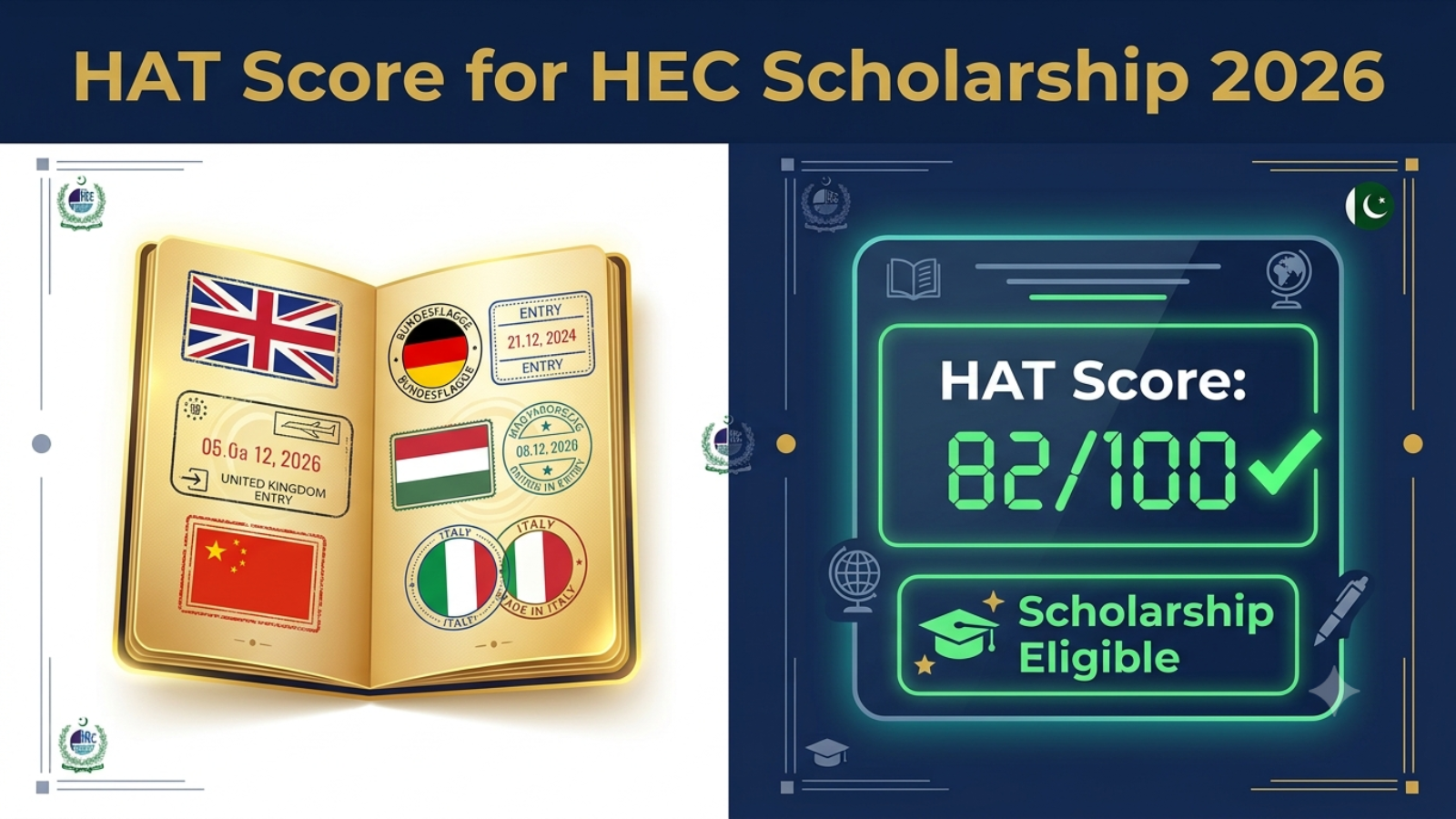
Your HAT score for HEC scholarship 2026 is not just a number. It is the single most important gate between you and a fully funded master’s or PhD degree abroad — in the UK, Hungary, China, Germany, or elsewhere. Every foreign scholarship program processed through HEC has a minimum HAT score requirement, and your score directly determines whether HEC even submits your name to the partner country.
This article breaks down exactly which scholarships need what HAT score, what each program offers, how the selection process really works, and what you must do right now after receiving your July 2026 HAT result.
Why Your HAT Score Controls Your Scholarship Application
Most Pakistani students think the scholarship application process starts after they pass the HAT test. That is wrong. Under the Learning Opportunities Abroad (LOA) framework, HEC accepts a valid HAT score as the mandatory pre-screening filter for all Master’s and PhD programs. Applicants for the Hungarian, Commonwealth, and Chinese Government scholarship programs are advised to obtain a valid HAT score before applying on the LOA portal. HEC
This means HEC does not even forward your application to the scholarship partner — whether that is the UK Commonwealth Scholarship Commission, the Hungarian Tempus Foundation, or the China Scholarship Council — unless your HAT score meets their threshold. HEC’s HAT score requirement serves as a pre-screening filter. Only candidates who meet the HAT threshold are submitted to partner programs. Scholarsfunds
Passing HAT with 50 marks is not enough to be competitive. As the competition is very high, you need to get more than 85 marks out of 100 to be seriously competitive for scholarship nominations. Many preparation books in the market only help students achieve 40 to 50 marks. Earnest Prep
Understanding this reality is why your HAT score matters far beyond just clearing the minimum.
Complete Breakdown — HAT Score Required for Each HEC Scholarship 2026
Here is every major HEC-processed foreign scholarship program with the exact HAT score requirement confirmed from official HEC sources:
Scholarship Program
Country
Level
Minimum HAT Score
Competitive Score
Commonwealth Scholarship
UK
MS / PhD
60 out of 100
80+
Stipendium Hungaricum
Hungary
MS / PhD
50 out of 100
70+
Chinese Government Scholarship (CSC)
China
MS / PhD
50 out of 100
70+
HEC Overseas PhD Phase-II
UK/USA/Europe/Australia
PhD only
70 out of 100
80+
Moroccan Government Scholarship
Morocco
MS / PhD
50 out of 100
65+
Azerbaijan Government Scholarship
Azerbaijan
MS / PhD
50 out of 100
65+
Cuban Government Scholarship
Cuba
MS / PhD
50 out of 100
60+
The “minimum” score gets your application processed. The “competitive” score gets you actually nominated and sent to the partner country.
1. Commonwealth Scholarship 2026 — UK (HAT 60+ Required)
The Commonwealth Scholarship is one of the most prestigious fully funded scholarships available to Pakistani students. To qualify, applicants must hold a first division in their 16-year Bachelor’s or Master’s degree, must not have a second or third division in their terminal degree, and must obtain a minimum score of 60 out of 100 in the HAT test. IELTS is not required by HEC — though individual UK universities may have their own English requirements. HEC
What the scholarship covers: full tuition, monthly living allowance, return airfare, and arrival allowance in the UK.
The selection process involves initial screening by HEC for academic records and HAT scores, followed by forwarding of eligible applications to the Commonwealth Scholarship Commission in the UK. A confirmed supervisor at a UK university increases your chances of nomination significantly. ACAD
The Commonwealth Scholarship application deadline was recently extended. HEC officially extended the deadline for Commonwealth Scholarships, with both the HEC e-portal and the CSC portal applications due by October 21, 2026. Applicants must submit two separate online applications — one on the CSC UK portal and another on the HEC e-portal. ACAD
HAT score needed to be competitive: 75 or above. With 60 you are eligible. With 75 you are competitive. With 80+ you are in a strong position.
The Stipendium Hungaricum is Hungary’s flagship scholarship program and one of the most accessible fully funded scholarships for Pakistani students because of its relatively lower HAT threshold. Without providing a minimum HAT score of 50 out of 100, applications will not be considered for further processing. The test score is automatically updated for scholarship nominations after results are announced — applicants do not need to add their marks manually. HEC
What the scholarship covers: full tuition waiver, monthly stipend, accommodation, and health insurance for study at Hungarian universities.
In case of final selection, applicants must sign a bond on legal/stamp paper committing to return to Pakistan and serve the country for a period as prescribed by HEC immediately after completing their degree. HEC
The GAT-General test conducted by NTS is not acceptable for this scholarship. Only the HAT test conducted by HEC is valid. HEC
HAT score needed to be competitive: 65 or above. This is the most accessible route to a fully funded European degree for students with a moderate HAT score.
3. Chinese Government Scholarship (CSC) 2026 — China (HAT 50+ Required)
The CSC scholarship through HEC requires HAT for MS and PhD programs. The passing marks for the HAT test are 50 out of 100 for this program. China has one of the highest numbers of scholarship seats available to Pakistani students annually through HEC. The scholarship covers full tuition, accommodation on campus, and a monthly stipend ranging from 3,000 to 3,500 RMB depending on the study level. GradWinner
Many CSC seats for Pakistan are processed via HEC. Applications for the Chinese Government Scholarship typically open between November and January. Velocitytv
Top Chinese universities for Computer Science and Cybersecurity under CSC include Tsinghua University, Peking University, Shanghai Jiao Tong University, and Zhejiang University — all ranked in the top 100 globally for Engineering and IT.
HAT score needed to be competitive: 65 or above for general universities. 75+ for top-tier universities like Tsinghua or Peking.
Apply at: scholarship.hec.gov.pk → Learning Opportunities Abroad → Chinese Government Scholarship
This is HEC’s own flagship PhD program that sends Pakistani scholars to world-ranked universities in the UK, USA, Europe, China, and Australia. Eligibility requires an MPhil or equivalent degree, minimum 3.0 CGPA, GAT-Subject 70+ percentile, age below 35, and a faculty or university nomination. This scholarship requires candidates to be working as a lecturer or researcher at an HEC-recognized institution in Pakistan. INFO
Candidates must have a minimum of 70% marks in a valid HEC Aptitude Test (HAT). HEC will consider the best HAT score from the last two years for shortlisting purposes. HEC
For the HEC Overseas PhD, selection is based on HAT score, GAT-Subject percentile, academic CGPA, quality of the research proposal, institutional nomination, and interview performance if shortlisted. What separates shortlisted applicants from rejected ones is proposal quality combined with credible institutional backing. Scholarsfunds
Important: If you are a fresh graduate and not currently employed as a lecturer at a Pakistani university, this specific program is not accessible to you. Look at the Commonwealth, CSC, or Stipendium Hungaricum routes instead.
HAT score needed: 70 is the minimum. 80+ makes you genuinely competitive.
5. Moroccan, Azerbaijani, and Cuban Government Scholarships (HAT 50+ Required)
These are less-known but very real fully funded opportunities available through HEC LOA. All applicants for foreign-funded scholarship programs are required to obtain a minimum score of 50% in HAT or USAT. Iba
Morocco offers fully funded scholarships at Hassan II University of Casablanca and Mohammed V University in French and Arabic-medium programs. Azerbaijan offers scholarships at Baku State University and Azerbaijan Technical University. Cuba offers medical and science scholarships at University of Havana.
These programs have significantly lower competition compared to UK or China routes, making them viable options for students with HAT scores in the 55–65 range who want to study abroad on a full scholarship.
How the HEC Scholarship Selection Process Actually Works
Understanding the process end to end prevents the most common mistakes Pakistani applicants make.
Stage 1 — HAT Score Verification. You appear in HAT and receive your result. Your score is automatically linked to your CNIC in the HEC database. You do not need to manually upload it for most programs — it is pulled directly.
Stage 2 — Application on HEC LOA Portal. You apply at scholarship.hec.gov.pk under Learning Opportunities Abroad. You select your target scholarship program and fill in academic details, upload documents, and submit your Statement of Purpose.
Stage 3 — HEC Pre-Screening. HEC filters all applications based on HAT score threshold, CGPA, degree completion, and document completeness. Applications below the minimum HAT score are rejected at this stage without being forwarded.
Stage 4 — Merit Ranking. Among those who clear the HAT threshold, HEC ranks candidates by a combination of HAT score, CGPA, and program-specific criteria. Merit is strictly based on HAT score for most HEC scholarship programs. HEC reserves the right to modify the selection criteria. Iba
Stage 5 — Nomination to Partner Program. HEC forwards the top-ranked candidates to the partner country’s scholarship body — CSC for China, Tempus for Hungary, CSC UK for Commonwealth. The partner then makes the final award decision based on their own criteria including research proposal, academic fit, and available seats.
Stage 6 — Bond Signing. Successful candidates sign a legal bond with HEC committing to return to Pakistan and serve the country for a period equal to the scholarship duration. This is mandatory for all HEC-processed foreign scholarships.
What HAT Score Do You Actually Need in 2026 to Win a Scholarship?
Let us be completely honest about this. The minimum score and the competitive score are very different numbers.
Passing with 50 marks does not mean success. Competition is very high and you realistically need more than 85 marks to stand out at the national level for scholarship nominations. Earnest Prep
Here is a practical score-to-scholarship guide based on real 2026 data:
HAT Score 50–59 — Eligible for Stipendium Hungaricum, CSC China, Morocco, Azerbaijan, Cuba. These programs have lower competition. Your chances are real if your CGPA is strong (3.0 or above) and your Statement of Purpose is excellent.
HAT Score 60–69 — Add Commonwealth UK to the list. You meet the minimum for the most prestigious HEC scholarship. However, with 60 you are at the floor of a very competitive pool. Strengthen your application with a confirmed UK supervisor and a strong research proposal.
HAT Score 70–79 — Opens the HEC Overseas PhD. You are now competitive for all major programs. Focus your energy on the Commonwealth and CSC China routes where 70+ puts you in a genuinely strong position.
HAT Score 80–84 — Top tier. You are among the strongest candidates nationally. Apply for Commonwealth, CSC China, Stipendium Hungaricum simultaneously. All three are realistic.
HAT Score 85+ — National top performer. You are in the top bracket. Every HEC scholarship program is accessible to you. Focus on the Commonwealth UK or HEC Overseas PhD for the most prestigious outcome.
Documents Required for HEC Scholarship Applications 2026
Regardless of which program you apply for, have these documents ready before the portal opens:
All degree certificates and transcripts (attested by HEC where required), CNIC copy, passport copy (valid for at least 2 years beyond your program end date), HAT scorecard, two strong recommendation letters from university professors, a Statement of Purpose (500–1000 words), a research proposal for PhD programs (2000–3000 words), English Medium Certificate from your previous institution if IELTS is not available, photograph on white background, medical fitness certificate (required for Hungarian scholarship), and domicile certificate.
Do not wait until applications open to collect these. Several documents — especially the English Medium Certificate, attested transcripts, and recommendation letters — take weeks to obtain. Start now.
How to Improve Your HAT Score for the Next Cycle
If your July 2026 HAT score did not reach the level you needed for your target scholarship, the September 2026 HAT test is your next opportunity. HEC considers the best HAT score from the last two years for shortlisting purposes. This means if you scored 68 in July and then score 78 in September, HEC will use 78 for your scholarship application. HEC
The most common reason candidates score below 70 is poor preparation strategy, not lack of ability. Most preparation books on the market are designed for passing, not for scoring 80+. Real past paper questions are the only reliable preparation material.
To genuinely push your score from 60 to 80, you need to:
Practice all 25 analytical reasoning tests from the Durrani HAT Prep Guide systematically — not randomly. Work through them in order, understand the logic rules for each scenario, and review every wrong answer before moving on. Analytical reasoning is the section where disciplined practice produces the fastest score improvement.
For Verbal Reasoning — which carries 50 marks — build vocabulary daily using GRE-level word lists. Learn 20 new words every day for 6 weeks. Focus specifically on antonyms, analogies, and sentence completion — these three subtypes appear most frequently in real HAT papers.
For Quantitative Reasoning — timed practice is everything. The questions are not difficult but 30 questions in limited time creates pressure. Do timed sets of 10 questions in 12 minutes until the pace feels natural.
Practice free with 474 real HAT MCQs from the Durrani PDF and HEC official sample paper:
👉 Free HAT Practice — 474 Real Questions: syedaounraza.online/hec-hat-test-preparation-2026/
Timeline — What to Do Right Now After Your July 2026 HAT Result
If your result is announced in August 2026:
August 2026 — Check your result at etc.hec.gov.pk. Identify your score and which scholarships you are eligible for. Begin collecting all required documents immediately.
August–September 2026 — Commonwealth Scholarship portal typically opens in August–September for the next cycle. If your score is 60+, apply immediately. Do not wait.
September–October 2026 — If your score was below your target, appear in the September 2026 HAT test. Prepare intensively for 6 weeks.
October 2026 — Commonwealth Scholarship 2026 application deadline is October 21, 2026 on both the HEC e-portal and the CSC UK portal.
November–January 2027 — CSC China and Stipendium Hungaricum applications typically open for the 2027–28 academic year. Begin preparing research proposals and contacting supervisors now.
Frequently Asked Questions — HAT Score and HEC Scholarships 2026
Q: What is the minimum HAT score for HEC scholarship? The minimum varies by program. Commonwealth UK requires 60. Stipendium Hungaricum and CSC China require 50. HEC Overseas PhD requires 70. To be genuinely competitive, aim for 80+.
Q: Is HAT score the only factor for HEC scholarship selection? No. For HEC scholarships, selection is based on HAT score, CGPA, quality of the research proposal, institutional nomination where applicable, and interview performance if shortlisted. Scholarsfunds
Q: Can I apply for multiple HEC scholarships with one HAT score? Yes. One valid HAT score (from the last 2 years) can be used to apply for all LOA programs simultaneously. You cannot receive two government scholarships at the same time, but you can apply for multiple programs and accept whichever you are awarded.
Q: Does HEC require IELTS for scholarship applications? HEC does not require IELTS score for scholarship applications. However, the applicant may need to fulfil the individual university’s English requirement. An English Medium Certificate from your previous institution is accepted as an alternative by HEC. HEC
Q: My CGPA is 3.17. Am I eligible? Yes. Most HEC LOA scholarship programs require a minimum CGPA of 3.0. A 3.17 CGPA meets the eligibility threshold for Commonwealth, CSC China, and Stipendium Hungaricum. Your HAT score and Statement of Purpose will be the deciding factors.
Q: How long is my HAT score valid for scholarship applications? HEC considers the best HAT score from the last two years for shortlisting purposes. Your July 2026 score is valid until July 2028. HEC
Q: Where do I apply for HEC foreign scholarships? Apply at scholarship.hec.gov.pk under the Learning Opportunities Abroad section.
Useful Official Links
HEC Scholarship Portal: scholarship.hec.gov.pk
HEC ETC Portal (HAT Result & Registration): etc.hec.gov.pk