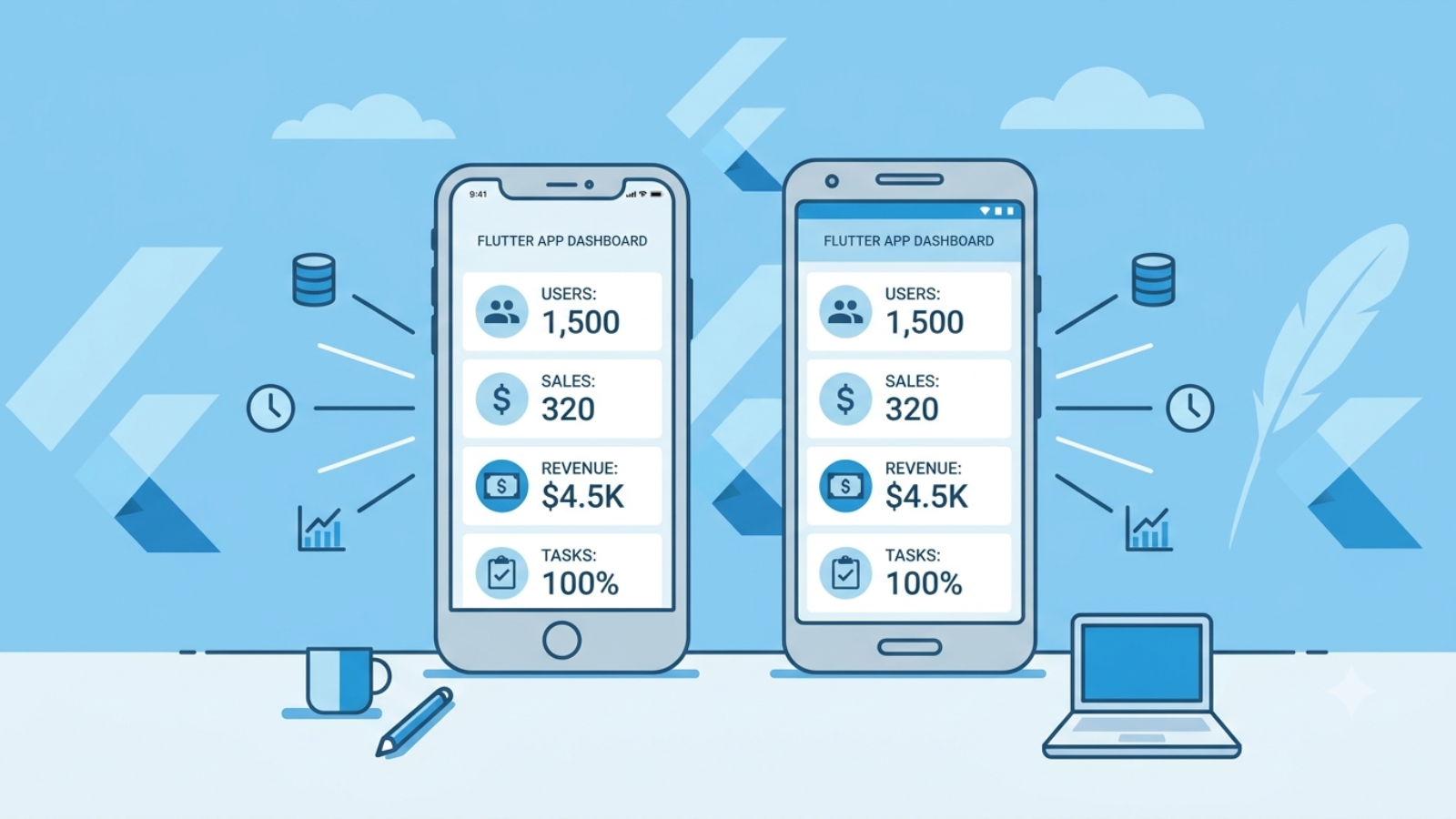

Startup founder and developer reviewing an app prototype while deciding how to hire a Flutter developer

How to Hire a Flutter Developer for Your Startup (2026 Checklist)

Quick answer: To hire a Flutter developer for your startup in 2026, check their Dart fluency, ask for a live GitHub repo (not just screenshots), confirm Firebase or backend experience, and get a fixed-scope quote before an hourly rate. Budget $3,000–$40,000 depending on app complexity, and always run a small paid test task first.

Founders come to me with the same worry almost every time: they’ve never hired a developer before, and they don’t know how to tell a good one from someone who’ll waste three months of runway. This checklist exists because of that gap.

Why Flutter Makes Sense for a Startup MVP

Flutter is Google’s open-source toolkit for building apps from a single codebase that runs on iOS, Android, web, and desktop. Instead of hiring separate iOS and Android teams, you hire one developer, or one small team, and ship to both platforms at once.

That matters most at the MVP stage. You don’t have the runway to duplicate work, and you probably don’t know yet which platform your users will actually prefer. Flutter buys you flexibility while you figure that out. According to Flutter’s official documentation, the framework compiles to native ARM code on mobile, so you’re not getting a watered-down hybrid app — you’re getting genuinely native performance from one codebase.

That said, Flutter isn’t magic. It won’t fix a poorly scoped project, and a weak developer writing sloppy Dart will still cost you more in rewrites than you saved on the framework.

The 2026 Checklist: What to Check Before You Hire

1. Can They Show You Real Dart Code, Not Just Screenshots?

A polished app store listing tells you almost nothing about code quality. Ask for a GitHub link or a code sample from a past project. Look for clean state management (Provider, Riverpod, or Bloc), not everything crammed into one giant widget file.

2. Do They Have Real Firebase or Backend Experience?

Most startup MVPs need user auth, a database, and push notifications — usually through Firebase. Google’s Firebase documentation covers the standard building blocks: Authentication, Firestore, and Cloud Functions. If your developer has never touched these, budget extra time for the learning curve, or extra cost for a backend specialist.

3. Can They Explain Their Testing Approach?

Ask directly: “How do you test before shipping?” A developer with real experience will mention widget tests or integration tests without hesitation. Someone who shrugs and says “I just test it manually” is a signal to slow down.

4. Have They Shipped an App That’s Still Live?

Ask for an App Store or Play Store link to something they built, not a demo video. A live app tells you they’ve handled the unglamorous parts too — store submission, crash reports, update cycles.

5. Do They Quote Fixed Scope Before Hourly Rate?

A developer who jumps straight to an hourly number without asking about your app’s actual features is quoting blind. The good ones ask questions first: user roles, offline support, payment integration, expected user volume.

What Does It Actually Cost to Hire a Flutter Developer?

Rates vary enormously by region and experience. Junior developers typically run $20–$40/hour, mid-level $30–$85/hour, and senior specialists $80–$150/hour or more in North America and Western Europe. Offshore rates in South Asia and parts of Latin America often run lower, sometimes $20–$50/hour for senior talent, though quality range widens considerably at that price point.

For total project cost, here’s a realistic breakdown for 2026:

  • Simple app (basic screens, no backend): $3,000–$10,000
  • Real business app (auth, payments, admin panel, notifications): $12,000–$40,000
  • Marketplace or complex multi-user platform: $25,000–$80,000+

Here’s the number that surprises most first-time founders: the cheapest hourly rate rarely produces the cheapest total cost. A developer at $20/hour who needs 200 hours because of rework costs more than one at $50/hour who finishes cleanly in 60. Ask about estimated hours before comparing rates side by side.

If you want a rough budget for your specific app idea before you request quotes, the Free Website Cost Calculator gives you a starting range in a couple of minutes.

Freelancer, Offshore Team, or Agency — Which Fits a Startup Budget?

A solo freelancer works well when your MVP has a clear, contained feature list and you’re comfortable being the project manager yourself. You get direct access to the person writing your code, and no markup for a middleman.

An offshore team or dedicated agency makes more sense once your app needs parallel workstreams — say, a designer building screens while a developer wires up the backend simultaneously. That coordination is worth paying for once your timeline gets tight.

For most pre-seed and early-stage startups I’ve worked with, a single senior full-stack freelancer who covers Flutter, Firebase, and basic backend logic is the sweet spot. You avoid agency overhead without sacrificing the technical depth an MVP actually needs.

[INSERT: a real startup client story — Flutter MVP built, actual timeline and cost, or a specific vetting mistake avoided]

The Mistake That Sinks Most First-Time Flutter Hires

Founders almost always start by comparing hourly rates. That’s backwards. The rate tells you nothing about how many hours a project will actually take, and a slow, expensive developer can be cheaper in total than a fast, cheap one who ships buggy code.

Instead, start with a small paid test task tied to your actual project — a login screen, a single API integration, anything real rather than a generic coding challenge. It costs you a few hundred dollars and tells you more about fit than a week of interviews would.

If you’re not sure whether Flutter is even the right platform for your idea versus, say, a native build or a no-code tool, the Platform Finder Quiz walks through the trade-offs in under two minutes.

Frequently Asked Questions

How much does it cost to hire a Flutter developer for a startup MVP?
A simple MVP typically costs $3,000–$10,000, while a fuller app with backend, auth, and payments runs $12,000–$40,000, depending on complexity and developer location.

Is Flutter a good choice for a startup’s first app?
Yes, for most startups. Flutter lets you launch on iOS and Android from one codebase, which saves both development time and long-term maintenance cost compared to building two native apps.

Should I hire a freelance Flutter developer or an agency for my startup?
A freelancer usually suits a startup with a clear, contained feature set and a tight budget. An agency or team is worth the premium once your app needs multiple people working in parallel to hit a deadline.

What should I ask a Flutter developer before hiring them?
Ask for a live GitHub repo or code sample, a link to a live app they’ve shipped, their approach to testing, and their experience with Firebase or your specific backend needs.

How long does it take to build a Flutter MVP?
A simple MVP typically takes 4–8 weeks. A more complete app with backend integration and testing usually takes 10–16 weeks, depending on scope and how quickly feedback loops move.

Do I need a separate backend developer if I hire a Flutter developer?
Not necessarily. Many Flutter developers handle Firebase-based backends themselves. For more complex custom backends, you may need a separate specialist alongside your Flutter developer.

Want a Second Opinion on Your App Idea?

If you’re still working out scope, budget, or whether Flutter is even the right call for your idea, message me on WhatsApp and I’ll give you a straight answer — no generic sales pitch, just what your project actually needs.

Flutter app development cost 2026 — freelancer vs agency pricing guide

Flutter App Development Cost in 2026: What Freelancers Actually Charge

Every article about Flutter app development cost is written by an agency trying to sell you a $50,000 project. This one isn’t.

I’m a freelance Flutter developer. I built and published Al Quran MP3 — a 114-surah audio streaming app — on both Google Play and the Apple App Store. I dealt with Apple rejections, fixed AVFoundation audio errors on iOS, implemented 512KB progressive buffering to handle streaming failures, and navigated every step of the submission process myself. I know what Flutter development actually costs because I’ve done the work, not just quoted for it.

Here’s what you’ll actually pay in 2026, depending on who you hire and what you’re building.

Why Flutter Costs Less Than You Think — And More Than Some Agencies Quote

Flutter is Google’s open-source framework for building apps that run on Android, iOS, web, and desktop from a single codebase. You write the code once and it works everywhere. That’s the real cost advantage — you’re not paying for two separate iOS and Android builds.

Agencies love quoting $50,000–$300,000 for Flutter projects. Some of those quotes are honest for large enterprise apps. Most are not what a small business or startup actually needs. The range that matters for 90% of real projects is much smaller.

A solo freelance Flutter developer with 2–3 years of production experience typically charges $25–$60 per hour depending on their location and the complexity of your project. A mid-level agency charges $80–$150 per hour. A top-tier US or UK agency charges $150–$300 per hour.

Same app. Dramatically different invoice.

What Flutter App Development Actually Costs by Project Type

Simple utility app — 5 to 8 screens, no backend, no login, basic navigation. Think a prayer times app, a currency converter, a unit calculator, or a basic audio player. A freelancer builds this in 2–6 weeks. Cost range: $1,500–$6,000 from a freelance developer. $15,000–$30,000 from an agency.

Standard business app — 10 to 20 screens, user login, a backend (Firebase or a REST API), push notifications, maybe payment integration. A delivery tracker, a booking app, a membership app. Freelancer cost: $5,000–$18,000. Agency cost: $30,000–$80,000.

Complex multi-feature app — real-time data, multiple user roles, custom animations, third-party integrations, admin dashboard. A marketplace, a healthcare platform, a logistics system. Freelancer cost: $15,000–$40,000 for a skilled solo developer. Agency cost: $80,000–$300,000+.

The gap between freelancer and agency pricing is not about quality. It’s about overhead. An agency charges for project managers, account managers, QA teams, and offices. A skilled freelancer charges for the actual development work.

✅ Pro Tip: For a simple to medium app with a clear scope, a freelance Flutter developer almost always delivers better value than an agency. The code quality can be identical — sometimes better, because a senior freelancer does the work personally rather than handing it to a junior developer on their team.

The Hidden Costs Nobody Puts in Their Quote

This is where budgets go wrong. The development cost is just one part of what you’ll actually spend.

Apple Developer Account — $99 per year. Required to publish on the App Store. Non-negotiable. If your developer is quoting you a “complete app” price, ask if this is included or separate.

Google Play Developer Account — one-time $25 fee. Much more reasonable, and it never expires.

App Store review time — Apple reviews take 1–7 days per submission. If they reject the app — and they will reject it at least once for almost every first-time submission — you fix the issue and resubmit. Add 1–2 weeks to your timeline for this. My Al Quran MP3 app was rejected twice before approval. Once for location permission handling and once under their similarity guideline. These rejections are normal. Budget time for them.

Backend hosting — if your app needs a server, database, or API, that’s a monthly cost. Firebase free tier handles small apps. Once you scale, Firebase bills can grow fast. A basic DigitalOcean or Hostinger VPS runs $6–$20 per month as an alternative.

Third-party APIs and services — payment gateways, mapping services, SMS verification, email providers. These have their own monthly costs that continue after launch. A Stripe integration, for example, takes 2.9% + $0.30 per transaction on top of development costs.

Maintenance — Flutter updates regularly. Dart updates. Android API levels change. Apple changes App Store requirements every year. Budget 10–20% of your initial development cost per year for ongoing maintenance. An app you build today without maintenance will have issues within 12–18 months.

⚠️ Watch Out: The most common budget mistake I see is clients who budget for development but not for the year after launch. Your app will need updates. Apple will require changes. Android will deprecate APIs. A developer who disappears after launch leaves you with an increasingly broken app and no one who understands the codebase to fix it.

Real Example: What Al Quran MP3 Cost to Build

My Al Quran MP3 app has 114 surahs, full audio streaming, an offline mode, a Qibla compass screen using device location, and is published on both Google Play and the Apple App Store.

The core development work — Flutter UI, audio integration using the just_audio package, surah listing, playback controls — took roughly 3 weeks of focused development time. The iOS problems added another week. AVFoundation on iOS handles audio streaming differently from Android. The app was silently failing on iOS when streaming audio files above a certain size. The fix was implementing 512KB progressive download buffering so the audio loads in chunks rather than attempting to stream the full file at once. That’s the kind of iOS-specific issue that doesn’t appear in Android testing and adds real hours to the project.

Total honest time investment: approximately 4 weeks from scratch to published on both stores. At a $40/hr freelance rate that would be around $6,400. At an agency rate of $120/hr it would be $19,200. Same app. Same result.

Flutter vs React Native: Which Costs Less?

If you’re comparing Flutter to React Native specifically on cost, the honest answer is that the framework is not the biggest cost driver — the developer is.

That said, Flutter has one real cost advantage: UI consistency. Flutter renders its own widgets and doesn’t rely on native components. This means what you build looks exactly the same on Android and iOS without platform-specific fixes. React Native uses native components, which behave slightly differently between platforms and often requires additional platform-specific code to make the UI consistent. That extra work costs extra hours.

For most business apps, Flutter is the better value choice in 2026. The exception is if your app needs deep integration with JavaScript libraries or your existing team is JavaScript-native — in which case React Native’s ecosystem may save you more time than Flutter’s rendering advantage.

How to Hire a Flutter Developer Without Getting Burned

  1. How to Hire a Flutter Developer Without Getting Burned

    Ask to see a published app. Not a demo. Not a GitHub repo. A live app in the App Store or Google Play that real users have downloaded. Anyone can build a demo. Shipping a production app through Apple’s review process is a different skill.
    Ask about iOS-specific experience separately. Flutter development on Android is relatively smooth. iOS is where problems appear — AVFoundation audio quirks, App Store review rejections, location permission handling, background processing limitations. A developer who has only ever built Android apps in Flutter will hit these problems on your iOS build and charge you for the time to figure them out.
    Ask how they handle App Store rejections. The right answer is that they expect them, have handled them before, and include at least one revision cycle in their quote. The wrong answer is that they’ve never been rejected — that means they’ve never shipped a real iOS app.
    Ask for a fixed-price quote for defined scope. If your app has clear, documented features, there’s no reason for hourly billing. A fixed price protects you from scope creep and incentivises the developer to work efficiently.
    ✅ Pro Tip: The best Flutter developers are not always the ones with the most expensive portfolios. Look for someone who has shipped at least 2–3 production apps across both stores, communicates clearly about technical problems, and gives you a detailed breakdown of what’s included in their quote. That combination matters more than years of experience or hourly rate.

What a Realistic Flutter App Budget Looks Like in 2026

If you’re a small business or startup planning a Flutter app, here’s how to think about your total budget.

Simple utility or content app on both stores: $2,000–$8,000 with a freelance developer, including Apple and Google developer accounts. Add $100–$200 per year for maintenance.

Standard business app with login, backend, and payments: $8,000–$20,000 with a skilled freelancer. Add $500–$2,000 per year for hosting and maintenance.

Complex app with real-time features, multiple roles, and custom integrations: $20,000–$50,000 with a senior freelancer or small specialist team. Ongoing costs depend heavily on backend complexity.

If an agency quotes you $80,000 for a simple business app, you are paying for their overhead, not your app. If a freelancer quotes you $500 for a complex multi-platform app, something is wrong. The real number for most projects sits between those extremes — and closer to the freelancer end than most agencies want you to believe.

FAQ

How much does a simple Flutter app cost in 2026?

A simple Flutter app — 5 to 8 screens, no complex backend, published on both Android and iOS — costs $1,500–$6,000 from a freelance developer. Agency pricing for the same scope typically starts at $15,000. The difference is overhead, not quality.

Is Flutter cheaper than building separate native apps?

Yes, significantly. A single Flutter codebase replaces two separate native builds — one for iOS in Swift and one for Android in Kotlin. You’re paying one developer for one codebase that works on both platforms. The saving is typically 35–45% compared to native development for standard business apps.

How long does it take to build a Flutter app?

A simple utility app takes 2–4 weeks. A standard business app takes 6–12 weeks. A complex multi-feature platform takes 3–6 months. These timelines assume clear scope from the start — vague requirements add weeks of back-and-forth that extend every estimate.

Do I need a Mac to develop a Flutter iOS app?

Yes. Building and testing for iOS requires a Mac with Xcode installed. This is Apple’s requirement, not Flutter’s. A developer working on Windows can build and test the Android version but cannot compile or submit the iOS version without a Mac. Always confirm your Flutter developer has Mac access before starting an iOS project.

How much does it cost to maintain a Flutter app after launch?

Budget 15–20% of your initial development cost per year. That covers operating system updates, Flutter framework updates, App Store compliance changes, and minor bug fixes. An app that costs $5,000 to build should have a maintenance budget of $750–$1,000 per year to stay functional and compliant.

Can I build a Flutter app for $1,000?

For a very simple single-platform app with no backend, possibly. For a dual-platform app published on both stores with real features, no. The Apple developer account alone costs $99 per year. A professional developer charging $30–$40 per hour will use 25–33 hours just to reach that budget, which isn’t enough for a polished, published app. Set $2,000 as your realistic minimum for anything worth launching.

Final Thoughts

Flutter app development cost in 2026 depends far more on who you hire than what framework you use. The agency quotes that dominate Google search results are written by companies with large sales teams and even larger overheads. A skilled freelance Flutter developer delivers the same technical output for a fraction of the price.

What you’re actually paying for is someone who has shipped real apps, understands the App Store submission process from experience, and can solve the iOS-specific problems that only appear when you’re building for production — not just for demo.

If you’re planning a Flutter app and want a realistic quote based on your actual requirements, get in touch at https://syedaounraza.online/contact/

AI chatbot feature integrated into a Flutter mobile app using Firebase

How to Add AI Features to a Flutter App with Firebase (2026)

Quick answer: You can add AI features to a Flutter app using Firebase AI Logic, which connects your app directly to Google’s Gemini models through a secure client SDK. This lets you build chatbots, smart recommendations, and content generation without managing your own backend server for basic use cases. Setup typically takes a few days depending on how deeply the AI feature is integrated into your app’s logic.

If you’re building a Flutter app in 2026, AI isn’t an add-on anymore — it’s often expected. Here’s exactly how to integrate it properly, using Google’s own recommended approach.

Why Firebase AI Logic Is the Right Starting Point

Firebase already handles authentication, databases, and hosting for most Flutter apps — so extending it to AI keeps everything in one ecosystem. According to Firebase’s official documentation, the AI Logic client SDKs are built specifically for mobile and web apps, offering security options against unauthorized clients along with integrations with other Firebase services, and are available in Dart for Flutter among other platforms. LOGEIX

This matters because it allows switching between Gemini API providers just by enabling a different API and changing a few lines of initialization code, and several client SDKs even support on-device inference that falls back to the cloud model when needed. LOGEIX

How the Integration Actually Works

Step 1: Set up Firebase AI Logic in the console
In the Firebase console, under AI Services, you select AI Logic and click “Get started” to launch a guided setup that configures the required APIs and resources for your project. You’ll choose between the Gemini Developer API (simpler, good for getting started) or Vertex AI Gemini API (more enterprise-focused, requires billing setup). SUSO

Step 2: Add the SDK to your Flutter app
The core package for this is firebase_ai, available on pub.dev, which supports all three major model types and is the central tool for connecting a Flutter client to Gemini. X

Step 3: Initialize Firebase in your app
This happens in your main.dart file, connecting your app to the Firebase project you configured, typically using the FlutterFire CLI to generate the right configuration files automatically.

Step 4: Create your model instance and start calling Gemini
Once initialized, you create a generative model instance and start sending prompts — this is the part that actually generates AI responses inside your app, whether that’s a chatbot reply, a content suggestion, or a data-driven recommendation.

Step 5: Test thoroughly before shipping
Because AI responses aren’t always predictable, test with a wide range of real user-style inputs, not just clean example prompts.

Full setup details are available directly in Firebase’s official AI Logic documentation, which covers platform-specific requirements for Flutter, Android, iOS, and web.

Security: Don’t Skip This Part

This is the step most tutorials gloss over, and it matters. If your Flutter app calls Gemini directly from the client, you should not commit your Firebase configuration file to a public repository, since anyone could reuse it to send requests to your AI endpoint, consuming quota and potentially causing billing costs. For production apps, the recommended approach is routing AI requests through a backend service — like Cloud Functions for Firebase or Cloud Run — so the backend, not the client, controls access. PeekYouPeekYou

In practice, this means: prototype quickly with direct client calls, but before launching publicly, move sensitive AI logic behind a backend function.

What You Can Actually Build

1. In-App AI Chat
A conversational assistant inside your app — for support, onboarding, or general Q&A. Google’s own AI Toolkit for Flutter provides ready-made chat widgets supporting multiturn conversations, streaming responses, and even voice input, built specifically around Firebase AI Logic. PeekYou

2. Smart Content Generation
Apps that generate personalized text — recipe suggestions, product descriptions, or learning content — based on simple prompts, without needing a custom-trained model.

3. Real-Time Recommendations
Using AI to suggest relevant options based on user behavior or stated preferences — practical for booking, e-commerce, or hospitality-style apps.

4. Live Voice/Video AI Interaction
The Gemini Live API enables low-latency, real-time voice and video interactions with a Gemini model, processing continuous streams of audio, video, or text to deliver immediate, human-like spoken responses. This is more advanced and best suited for apps where natural conversation is core to the experience. Quotes

What This Typically Costs

  • Basic AI chat feature (client-side, simple prompts): Lower cost, often a few days of integration work
  • Custom AI feature with backend security (Cloud Functions, production-ready): Mid-range cost, more setup time due to the added backend layer
  • Advanced features (Live API, voice/video, multi-step AI workflows): Higher cost, scoped individually based on complexity

As always, the only accurate way to budget is scoping your exact feature list with a developer rather than relying on generic estimates.

Mistakes to Avoid

  • Committing API keys or Firebase config files to public repositories — this is a real, common security mistake
  • Skipping Firebase App Check — this helps protect your API from abuse and unauthorized use
  • Building only for the “happy path” — test with messy, unexpected user inputs before launch
  • Going straight to advanced features — start with a simple chat or recommendation feature, validate it works well, then expand

Frequently Asked Questions

Do I need a backend server to add AI to a Flutter app?
Not necessarily for prototyping — Firebase AI Logic supports direct client-side calls. For production apps, routing through a backend (like Cloud Functions) is the safer, recommended approach.

Which AI model does Firebase AI Logic use?
It connects to Google’s Gemini models, with options to use either the Gemini Developer API or the Vertex AI Gemini API depending on your project’s needs.

Is this only for chatbots?
No — it supports chat, content generation, recommendations, and even real-time voice/video interaction through the Gemini Live API.

How secure is this approach?
When set up correctly (using Firebase App Check and, for production, backend-routed requests), it’s designed specifically to prevent API key exposure and abuse.


Want AI features built into your Flutter app the right way — secure, scoped, and production-ready? Contact us with your app idea for a quote.