
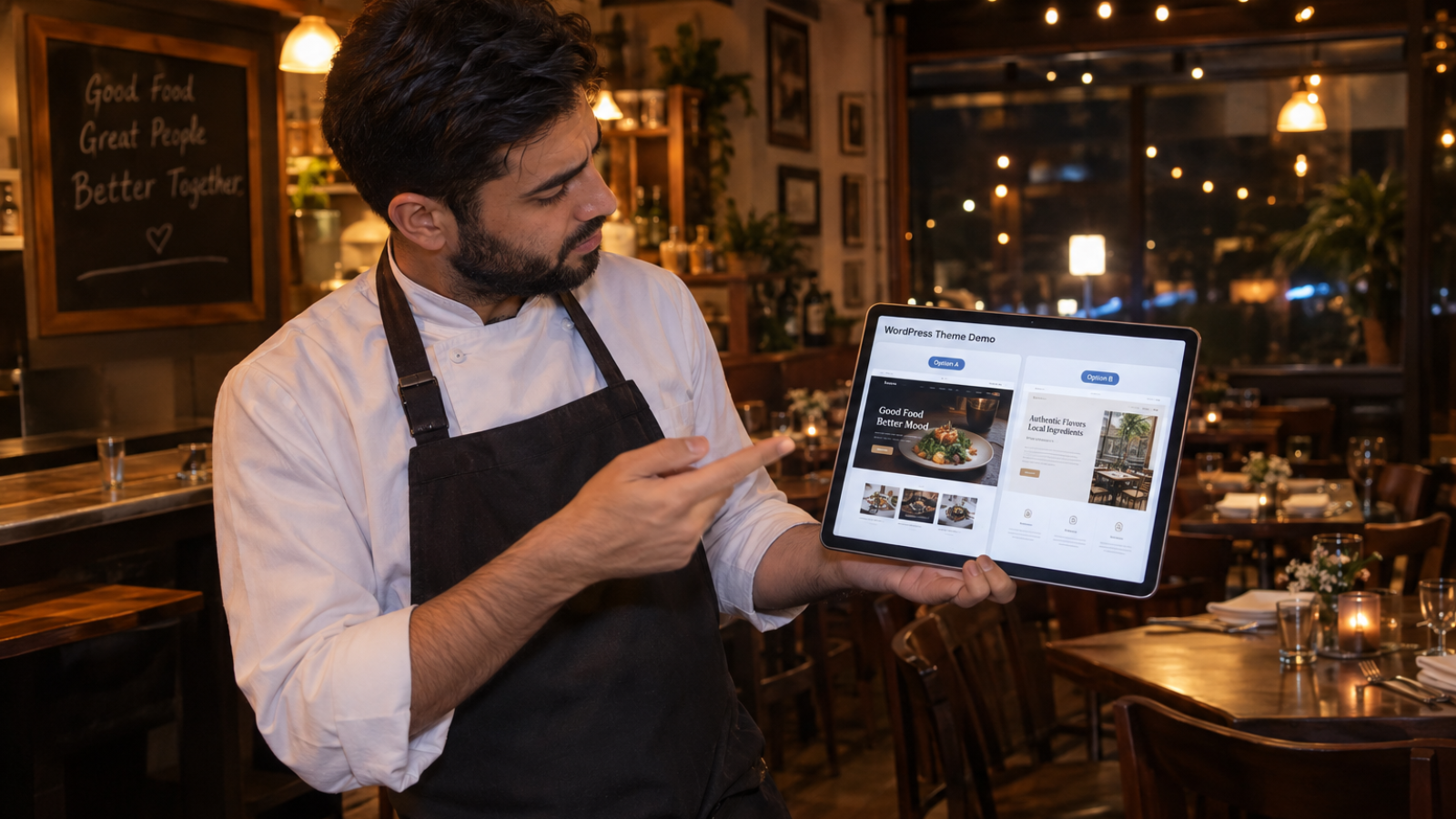
The best WordPress themes for restaurants in 2026 aren’t necessarily the ones with the flashiest food photography demos. Lightweight, well-coded themes like Astra, Kadence, and GeneratePress consistently outperform heavy niche “restaurant” themes on speed and reliability, which matters because slow menu pages cost you hungry visitors before they ever see your food.
Every “best restaurant themes” list I’ve read online ranks themes by how good the demo photos look. That’s the wrong metric. A restaurant site has one job: get someone from “I’m hungry” to “I booked a table” or “I placed an order” as fast as possible. Speed and clarity beat visual flair almost every time.
Here’s how I actually pick a theme for restaurant clients, and which ones I reach for first.
Why Does Theme Choice Matter More for Restaurants Than Other Businesses?
Restaurant websites get impulsive traffic. Someone’s hungry right now, searching on their phone, deciding fast. According to the National Restaurant Association’s 2026 State of the Restaurant Industry report, restaurant and foodservice sales are projected to reach $1.55 trillion this year, with operators continuing to invest heavily in digital ordering and technology to capture that demand.
That demand is mostly mobile, and it’s mostly impatient. A theme that loads slowly on a phone, or buries the menu behind a heavy image slider, loses that visitor to the next search result. That’s why I judge restaurant themes on performance first, design second — not the other way around.
The Debate Nobody Has: Niche “Restaurant” Themes vs. Lightweight Frameworks
Most theme marketplaces sell you a “restaurant theme” packed with a video hero, animated menu cards, parallax scrolling, and a built-in reservation widget. It looks impressive in a demo. It’s also often bloated with CSS and JavaScript you’ll never fully use.
Here’s my actual stance: I build most restaurant sites on a lightweight, general-purpose theme — Astra, Kadence, or GeneratePress — paired with Elementor, rather than a heavy niche restaurant theme. These frameworks load fast by default, and I only add the specific features (menu layout, reservation embed, gallery) the client actually needs, instead of inheriting a theme’s entire feature bloat.
That’s a deliberate trade-off. A niche theme gets you to a finished-looking demo faster. A lightweight framework takes a bit more setup time but gives you a site that stays fast as Google’s Core Web Vitals standards keep raising the bar. According to Google’s own web.dev documentation, pages need to load their main content in under 2.5 seconds to be considered “good” — a threshold that heavy demo themes struggle to hit out of the box.
The Themes I Actually Recommend
Astra
Astra is my default starting point for most small restaurant sites. It’s lightweight, has solid Elementor compatibility, and its restaurant starter templates give clients a familiar layout to customize without extra bloat.
Kadence
Kadence offers more built-in design flexibility than Astra while staying performance-focused. For restaurants that want more visual control over menu layouts and featured-dish sections without sacrificing speed, this is often my second pick.
GeneratePress
GeneratePress’s modular system lets you enable only the features you need, keeping the site genuinely lightweight. I recommend this specifically for restaurants focused on local SEO, since page speed directly affects how well you rank for “restaurants near me” searches.
Delicio (for Turnkey Demo Setups)
If a client wants a faster path to a finished-looking site and is comfortable with a slightly heavier build, Delicio includes a built-in reservation system and menu builder designed specifically for restaurants. It’s a reasonable choice when budget or timeline doesn’t allow for custom setup, as long as you’re aware of the performance trade-off.
What to Check Before Choosing Any Theme
Don’t pick based on screenshots alone. Check these first:
- WooCommerce compatibility, if you plan to add online ordering or gift card sales later
- Reservation plugin compatibility — confirm the theme works cleanly with OpenTable, Tock, or whatever booking tool you use
- Mobile menu display, since a cramped or hard-to-tap menu on mobile directly costs you orders
- Real performance numbers, not marketing claims — test the actual demo site through PageSpeed Insights before committing
- Update frequency, since an abandoned theme becomes a security and compatibility risk within a year or two
I’ve written more about diagnosing and fixing WordPress speed issues in how I improve Core Web Vitals on WordPress — the same principles apply directly to restaurant sites, since menu pages with heavy image galleries are one of the most common Core Web Vitals failure points I see.
A Mistake I See Restaurant Owners Make Constantly
Restaurant owners often pick a theme based purely on how the demo food photography looks, then load their own lower-quality phone photos into that same layout. The result looks worse than a simpler theme with properly shot images would. A great theme with mediocre photos underperforms a simple theme with excellent photos, every time. If your budget only stretches to one investment, spend it on professional food photography before spending it on a premium theme.
[INSERT: a real client example here — e.g., a restaurant site where switching from a heavy niche theme to a lightweight framework improved load time or bookings]
Red Flags When Choosing a Restaurant Theme
- No recent updates. A theme untouched for over a year risks compatibility issues with current WordPress versions.
- Demo looks fast, live sites don’t. Always test a theme’s actual customer sites, not just the polished demo.
- Reservation or ordering features locked behind a separate paid add-on you didn’t budget for.
- No mobile-specific menu layout, which is a serious problem given how much restaurant traffic comes from phones.
Should You DIY This or Hire Someone?
If you’re comfortable with WordPress basics, a lightweight theme plus a simple booking plugin is genuinely doable yourself. Where I see clients get stuck is customizing menu layouts to look clean on mobile, or connecting a reservation system without breaking page speed. That’s usually where a few hours of professional setup pays for itself quickly.
If you want a realistic number for a full restaurant site build before you commit to a theme or a developer, run it through my website cost calculator first. It takes a couple of minutes and gives you a grounded starting point.
Frequently Asked Questions
What is the best free WordPress theme for a restaurant?
Astra and GeneratePress both offer strong free versions that work well for restaurant sites, especially when paired with Elementor for menu and gallery customization.
Do restaurant websites need a special WordPress theme?
Not necessarily. A lightweight, general-purpose theme with good page-building flexibility often outperforms a heavy niche “restaurant” theme, especially on page speed and mobile usability.
Should a restaurant theme include a built-in reservation system?
It’s convenient but not essential. Many restaurants achieve better results pairing a lightweight theme with a dedicated reservation plugin like OpenTable or Tock, rather than relying on a theme’s built-in system.
Does theme choice affect restaurant website SEO?
Yes, significantly. Slow-loading themes hurt Core Web Vitals, which Google factors into rankings, and can cause potential customers to leave before your menu even loads.
How much does a restaurant WordPress website cost?
Costs vary based on features and design complexity, typically ranging from $1,500 for a simple menu-and-contact site to $8,000+ for a build with online ordering and custom reservation integration.
Can I add online ordering to any WordPress restaurant theme?
Most modern themes support WooCommerce or dedicated food-ordering plugins, but it’s worth confirming compatibility before choosing a theme if online ordering is a priority from day one.
Not Sure Which Theme Fits Your Restaurant?
If you’d rather skip the trial-and-error and get a straight recommendation for your specific setup, message me on WhatsApp and I’ll tell you honestly what I’d build. Start the conversation here.