

Developer and business owner comparing WordPress vs Webflow site builders on a laptop

WordPress vs Webflow: Best Choice in 2026?

Quick answer: WordPress vs Webflow really comes down to who builds and maintains your site. WordPress gives more long-term flexibility and lower baseline costs, but it needs ongoing upkeep. Webflow bundles hosting, security, and design power into one polished tool, at a higher monthly price. Pick WordPress for open-ended growth. Pick Webflow if you want design control without managing a server.

Why Business Owners Keep Asking This Question

I get this comparison in client calls more than almost any other platform question. That’s because WordPress and Webflow both attract design-conscious business owners, just from opposite directions.

WordPress started as a blogging tool and grew into the web’s dominant CMS. Webflow started as a visual design tool for developers and grew into a full hosting platform. Both now compete for the same small business budget.

Neither one is a downgrade from the other, though people often frame it that way. They’re built on different philosophies, and that difference matters more than any single feature comparison.

What Actually Separates WordPress From Webflow?

Here’s the shortest way to explain it: WordPress separates your website’s “engine” from its hosting. Webflow keeps everything under one roof.

With WordPress, you choose your own host, pick from thousands of themes, and add functionality through plugins. That openness is powerful, but it also means version conflicts, security patches, and hosting decisions land on your plate.

With Webflow, hosting, security, and updates come built in. You design visually, inside Webflow’s own editor, and publish with one click. You give up some of WordPress’s raw flexibility in exchange for a far smoother day-to-day experience.

How Much Does Each Platform Actually Cost in 2026?

Pricing shifted for Webflow this year, and it’s worth knowing before you compare numbers you find elsewhere.

Webflow overhauled its plans in May 2026. Webflow’s own pricing page confirms the change. A standard content-rich site now runs on the Premium plan at $25 per month, billed yearly. That plan replaced the older separate CMS and Business tiers. A simpler, CMS-free site can run on the Basic plan at $15 per month instead.

WordPress software itself is free. However, real costs still apply. Expect to pay for hosting, typically $5 to $30 per month for small business sites. Add a premium theme or custom build on top, plus ongoing maintenance if you’re not handling updates yourself.

Here’s the nuance most comparisons skip: Webflow’s price is nearly all-inclusive. WordPress’s low starting cost can grow once you add premium plugins, a security service, and a developer’s time for maintenance. Total cost of ownership over a few years often ends up closer between the two than the sticker price suggests.

When Does WordPress Win?

WordPress tends to make more sense in these situations:

  • You expect the site to grow into e-commerce, memberships, or booking systems with custom logic
  • You want full ownership of your code and content, without depending on one company’s platform
  • Your team already manages other WordPress sites and has existing workflows
  • You need very specific plugin functionality that Webflow doesn’t offer natively

If you’re comparing platforms more broadly, our guide on WordPress vs Wix covers a similar decision from a different angle. It’s built for business owners weighing simplicity against control.

When Does Webflow Win?

Webflow tends to win for design-focused businesses that want a polished, custom look without touching a plugin ecosystem.

It fits agencies, studios, and brand-conscious startups that care deeply about pixel-level design control. It also fits teams without a dedicated developer, since Webflow’s visual editor removes most of the technical overhead WordPress requires.

The Trade-Off Nobody Mentions: Getting Your Site Out

Most comparisons stop at design and pricing. Almost none mention what happens if you ever want to leave.

WordPress content lives in an open database. If you switch hosts, themes, or even platforms entirely, your content generally moves with reasonable effort. That portability is one of WordPress’s quiet advantages.

Webflow doesn’t work the same way. You can export static HTML and CSS. Dynamic CMS content, though, won’t reimport anywhere else — Webflow’s own documentation confirms this. That’s fine if you’re happy with Webflow long-term. It’s a real constraint if you value the option to switch platforms later.

My Honest Take: Match the Platform to Who’s Maintaining It

Here’s where I’ll disagree with a lot of generic advice. The “best” platform depends less on features and more on who’s going to run the site day to day.

If you or your team can commit to occasional WordPress maintenance, its flexibility and lower long-term cost usually win. If you’d rather pay a bit more and never think about updates, Webflow’s all-in-one model earns its price. Neither choice is a mistake. The mistake is picking based on hype instead of your actual maintenance capacity.

Still unsure which fits your business? Our platform finder quiz asks a few quick questions. It points you toward the platform that matches your goals and budget.

Frequently Asked Questions

Is Webflow better than WordPress for small businesses? Not universally. Webflow suits design-focused businesses that want an all-in-one, low-maintenance platform. WordPress suits businesses that expect to grow in complexity and want more long-term flexibility.

How much does Webflow cost compared to WordPress in 2026? Webflow’s Premium plan runs $25 per month billed yearly, all-inclusive. WordPress software is free, but hosting, themes, and maintenance add up too. The total often lands similar, or slightly lower, depending on your setup.

Can I move my Webflow site to WordPress later? Not easily. Webflow lets you export static HTML and CSS, but dynamic CMS content doesn’t transfer directly. A full migration usually means rebuilding the content structure.

Is WordPress harder to maintain than Webflow? Yes, generally. WordPress requires plugin updates, security monitoring, and occasional troubleshooting. Webflow handles hosting, security, and updates centrally, which removes most of that ongoing work.

Which platform is better for SEO, WordPress or Webflow? Both can rank well when set up properly. WordPress offers more granular SEO control through plugins like Yoast. Webflow, on the other hand, gives you clean, standards-based code and fast hosting. That’s a strong technical SEO foundation right out of the box.

Do I need a developer to build a Webflow site? Not necessarily for simple sites, since Webflow’s visual editor is built for non-developers. However, complex interactions, custom integrations, or CMS-heavy builds usually benefit from professional help.

Still weighing WordPress against Webflow for your specific project? Message me on WhatsApp and tell me what you’re building. I’ll give you a straight recommendation, not a pitch for whichever platform pays better.
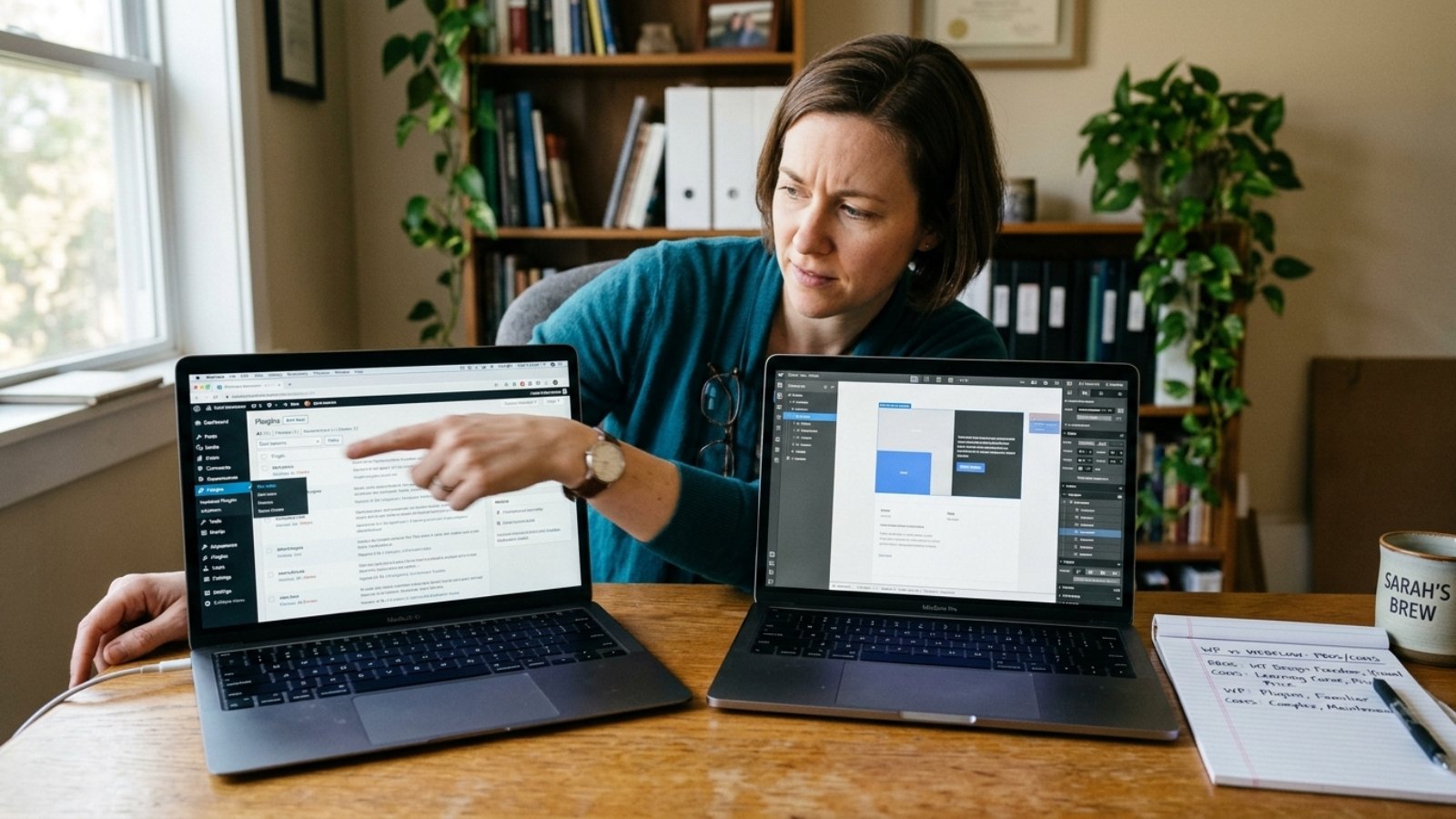
Small business owner comparing WordPress vs Webflow interfaces side by side before choosing a platform

WordPress vs Webflow: Which Is Better for Small Business?

Quick answer: WordPress vs Webflow comes down to flexibility versus predictability. WordPress costs less upfront and scales further, but you own the maintenance. Webflow bundles hosting, security, and updates into one monthly fee, which usually costs more over time but saves you from ongoing technical management.

I get asked this comparison constantly, usually from someone who’s already spent an hour reading conflicting blog posts. Here’s the honest version, not the version written by someone selling one platform over the other.

The Core Difference You Actually Need to Understand

WordPress is open-source software you install on hosting you choose. That gives you total control, an enormous plugin ecosystem, and no platform lock-in. However, you’re also responsible for updates, security, and backups, unless you pay someone else to handle them.

Webflow is a hosted platform where design, hosting, and infrastructure come bundled together. You get predictable pricing and built-in security, but you’re building inside Webflow’s ecosystem specifically, with far fewer third-party plugins available compared to WordPress.

Neither approach is objectively better. They’re built for different priorities, and that’s exactly why this comparison keeps confusing people who expect a single clear winner.

What Do They Actually Cost in 2026?

Webflow’s paid plans run $14 to $39 a month for standard business use, according to Webflow’s official pricing page, with hosting, SSL, and backups included in that fee. A professional Webflow build for a small business typically costs $3,000 to $15,000 upfront.

WordPress itself is free, but that number is misleading on its own. Shared hosting runs $5 to $30 a month, while managed WordPress hosting runs $30 to $100 a month. Add premium themes, plugins, and a professional build, and total upfront cost typically lands between $2,000 and $8,000, similar to figures I’ve broken down in my small business website cost guide.

Here’s the part that changes the comparison entirely: over three years, a typical Webflow small business site often lands around $4,500 to $15,000 all-in, while a comparable WordPress site frequently reaches $8,000 to $40,000 once ongoing maintenance gets factored in. WordPress looks cheaper at launch. It doesn’t always stay that way.

When WordPress Actually Wins

WordPress remains the dominant CMS by a wide margin. According to W3Techs’ usage tracking, WordPress powers a substantial share of all websites globally, far more than any single competitor. That scale brings real advantages: more developers available, more plugins for nearly any function, and no risk of the platform disappearing or pivoting business models.

WordPress wins clearly for content-heavy sites, blogs publishing frequently, and businesses planning significant future growth or custom functionality. If you eventually need something highly specific, a custom booking system, a complex membership structure, a niche integration, WordPress’s plugin ecosystem almost always has a path forward. Webflow’s more closed ecosystem sometimes doesn’t.

WordPress also wins if you genuinely plan to manage the site yourself long-term and don’t mind learning the admin dashboard. Its interface, while not simple, has decades of tutorials and community support behind it.

When Webflow Actually Wins

Webflow wins clearly for design-first businesses where visual polish and brand storytelling matter more than backend complexity. Its visual builder gives designers pixel-level control that WordPress themes rarely match without custom development.

It also wins for businesses that want to avoid technical management entirely. No plugin updates to track, no security patches to apply, no separate hosting bill to manage. That predictability has real value if you’d rather spend your time running your business than maintaining a website.

For marketing teams that need to launch landing pages quickly and independently, Webflow’s editor allows same-day publishing without developer involvement for routine changes. That speed advantage is real, and it’s one WordPress struggles to match without significant custom setup.

The Hidden Cost Most Comparisons Get Wrong

Here’s my honest opinion after building on both platforms: most “WordPress vs Webflow” comparisons undersell WordPress’s true long-term cost. The free software narrative hides developer time for plugin updates, security patches, and compatibility testing after WordPress core updates, costs that rarely show up in a simple pricing chart.

That doesn’t make Webflow automatically the better choice. It means the comparison isn’t really “free versus paid.” It’s “pay upfront and maintain it yourself versus pay monthly and let someone else maintain it.” Frame the decision that way, and it becomes much easier to answer honestly for your specific situation.

If you’re weighing a WordPress build and want realistic numbers on developer costs specifically, my WordPress developer cost breakdown covers current 2026 rates in detail.

Does the Platform Choice Affect SEO?

Both platforms can rank well when built properly. Neither one has an inherent SEO advantage baked into the platform itself. Execution, content quality, site structure, and technical health matter far more than which CMS powers the site underneath.

That said, WordPress’s plugin ecosystem gives you more granular SEO control if you want it, while Webflow’s built-in performance and clean code output can mean less optimization work needed out of the box. Neither difference is large enough to be the deciding factor on its own.

If you want a clear number for your specific project on either platform, the Free Website Cost Calculator gives you a realistic starting range in a couple of minutes.

Frequently Asked Questions

Is WordPress or Webflow cheaper for a small business?
WordPress usually costs less upfront, $2,000–$8,000 for a professional build, but Webflow’s bundled hosting and maintenance can make it cheaper over three years once WordPress’s ongoing maintenance costs are factored in.

Which platform is easier to manage without a developer?
Webflow is generally easier for non-technical owners, since hosting, security, and updates are handled automatically. WordPress requires more ongoing technical management unless you hire someone for maintenance.

Does Webflow rank as well as WordPress on Google?
Yes, both platforms can rank well when built properly. SEO success depends far more on content quality and site structure than which CMS powers the site.

Can Webflow handle complex custom functionality like WordPress can?
Not always as easily. WordPress’s plugin ecosystem is significantly larger, so highly specific or custom features often have more available solutions on WordPress than on Webflow.

Is WordPress still the most popular website platform in 2026?
Yes. WordPress remains the dominant content management system by a wide margin, according to W3Techs’ usage tracking across the web.

Should a growing business choose WordPress or Webflow?
It depends on growth type. Content-heavy or feature-heavy growth usually favors WordPress’s ecosystem, while design-focused, low-maintenance growth often favors Webflow’s simplicity.

Still Not Sure Which Platform Fits Your Business?

If you’re weighing WordPress against Webflow for your specific project, message me on WhatsApp and tell me what you’re building. I’ll give you a straight, platform-agnostic answer based on what actually fits your needs.